GOB Chemistry
My Course
Learn
Exam Prep
AI Tutor
Study Guides
Textbook Solutions
Flashcards
Explore
Try the app
My Course
Learn
Exam Prep
AI Tutor
Study Guides
Textbook Solutions
Flashcards
Explore
Try the app
Back
Henderson-Hasselbalch Equation quiz
You can tap to flip the card.
What does the Henderson-Hasselbalch equation allow you to calculate?
You can tap to flip the card.
👆
What does the Henderson-Hasselbalch equation allow you to calculate?
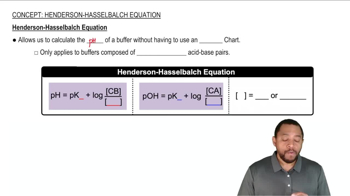
It allows you to calculate the pH of a buffer solution without using an ICE chart.
Track progress
Control buttons has been changed to "navigation" mode.
1/15
Related flashcards
Related practice
Recommended videos
Henderson-Hasselbalch Equation definitions
Henderson-Hasselbalch Equation
14 Terms
Henderson-Hasselbalch Equation
10. Acids and Bases
1 problem
Topic

Jules
Strong Acid Strong Base Titrations (Simplified)
10. Acids and Bases
6 problems
Topic
Jules
10. Acids and Bases - Part 1 of 2
6 topics
13 problems
Chapter
Jules
10. Acids and Bases - Part 2 of 2
8 topics
13 problems
Chapter
Jules
Guided course
02:35
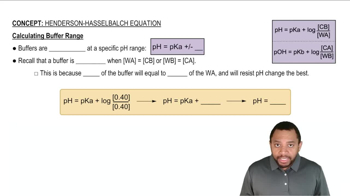
Calculating Buffer Range
2689
views
6
rank
Guided course
01:22
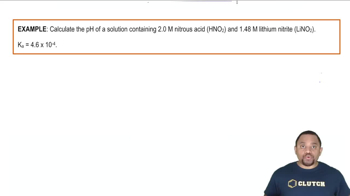
Henderson-Hasselbalch Equation Example
3202
views
6
rank
Guided course
01:22
Henderson-Hasselbalch Equation
3408
views
7
rank
Terms in this set (15)
Hide definitions
What does the Henderson-Hasselbalch equation allow you to calculate?
It allows you to calculate the pH of a buffer solution without using an ICE chart.
What type of chemical pair must a buffer contain for the Henderson-Hasselbalch equation to apply?
The buffer must be composed of a conjugate acid-base pair.
What is the Henderson-Hasselbalch equation when given the Ka of a buffer?
The equation is pH = pKa + log(conjugate base/weak acid).
What is the Henderson-Hasselbalch equation when given the Kb of a buffer?
The equation is pH = pKb + log(conjugate acid/weak base).
What units can be used inside the brackets of the Henderson-Hasselbalch equation?
You can use either molarity (concentration) or moles inside the brackets.
How do you calculate moles for use in the Henderson-Hasselbalch equation?
Moles are calculated as liters times molarity.
Within what pH range is a buffer most effective according to the Henderson-Hasselbalch equation?
A buffer is most effective within the range pH = pKa ± 1.
What happens to the Henderson-Hasselbalch equation when the concentrations of conjugate base and weak acid are equal?
The log term becomes zero, so the equation simplifies to pH = pKa.
What is the ideal buffer situation according to the Henderson-Hasselbalch equation?
The ideal buffer occurs when the concentration of weak acid equals the concentration of conjugate base.
What is the value of log(1) in the Henderson-Hasselbalch equation?
Log(1) equals 0.
How does the Henderson-Hasselbalch equation simplify when conjugate acid and weak base concentrations are equal?
It simplifies to pH = pKb.
Why is a buffer most effective when the concentrations of its components are equal?
Because the pH equals the pKa or pKb, which resists pH changes best.
What does the log term in the Henderson-Hasselbalch equation represent?
It represents the ratio of the concentrations (or moles) of the buffer components.
What is the main purpose of a buffer in a solution?
A buffer resists sharp changes in pH within its effective range.
When should you use the pKa version of the Henderson-Hasselbalch equation?
Use the pKa version when you are given the Ka of the buffer solution.