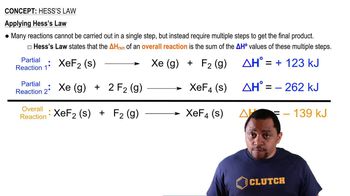
A principle stating that the total enthalpy change for a reaction is the sum of the enthalpy changes for each step, regardless of the reaction pathway.
Thermochemical Equation
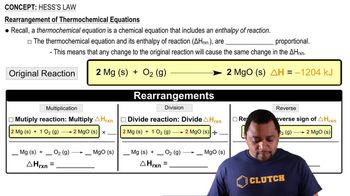
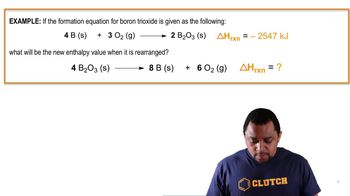
A chemical equation that includes the enthalpy change, showing the energy absorbed or released during a reaction.
Enthalpy of Reaction
The heat energy change associated with a chemical reaction, often represented as delta H.
Delta H
A symbol representing the enthalpy change for a reaction, indicating whether heat is absorbed or released.
Coefficient
A number placed before a chemical formula in an equation, indicating the relative amount of each substance involved.
Reaction Intermediate
A substance produced and consumed in multi-step reactions, appearing on both sides of partial equations and canceling out.
Partial Reaction
An individual step in a multi-step process, each with its own enthalpy change, contributing to the overall reaction.
Standard Enthalpy Value
A measured enthalpy change under standard conditions, used to calculate overall enthalpy changes in reactions.
Product
A substance formed as a result of a chemical reaction, appearing on the right side of a chemical equation.
Reactant
A starting substance in a chemical reaction, found on the left side of a chemical equation.
Sign Reversal
A change in the direction of a reaction that causes the enthalpy value to switch from positive to negative or vice versa.
Kilojoule
A unit of energy commonly used to express enthalpy changes in chemical reactions.
Multi-step Reaction
A process involving several sequential reactions, each with its own enthalpy change, summed to find the total change.
Cancellation
The process where identical substances on both sides of combined equations are removed, simplifying the overall reaction.
Overall Reaction
The final chemical equation obtained after combining all partial reactions and canceling intermediates.