Back

Hydration Reaction definitions

Control buttons has been changed to "navigation" mode.
1/15
  • Hydration Reaction

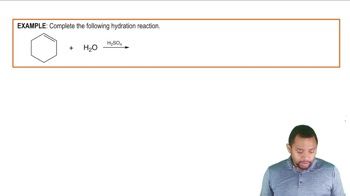
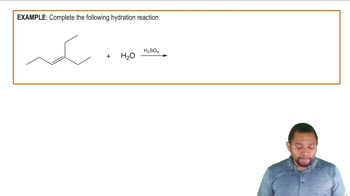
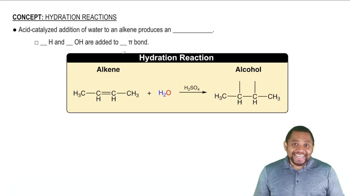
    Acid-catalyzed process where water adds across an alkene's double bond, converting it into an alcohol.
  • Alkene

    Hydrocarbon containing a carbon-carbon double bond, serving as the starting material in hydration.
  • Alcohol

    Organic compound formed when water adds to an alkene, characterized by an -OH group.
  • Sulfuric Acid

    Strong acid used as a catalyst to initiate and speed up the hydration of alkenes.
  • Catalyst

    Substance that increases the rate of a chemical reaction without being consumed, such as sulfuric acid here.
  • Pi Bond

    Type of bond present in alkenes, broken during hydration to allow addition of water components.
  • Symmetrical Alkene

    Alkene where both double-bonded carbons have identical groups, allowing water to add to either carbon.
  • Asymmetric Alkene

    Alkene with double-bonded carbons having different numbers of hydrogens, leading to regioselective addition.
  • Markovnikov's Rule

    Guideline stating that in asymmetric alkenes, hydrogen adds to the carbon with more hydrogens.
  • Major Product

    Predominant compound formed in hydration, resulting from Markovnikov's rule being followed.
  • Minor Product

    Compound formed in much smaller amounts, resulting from the opposite of Markovnikov's rule.
  • Double Bond

    Bond between two carbons in alkenes, broken during hydration to allow addition of H and OH.
  • Regioselectivity

    Preference for one direction of chemical bond making or breaking over all possible directions in a reaction.
  • Hydrogen Atom

    Component from water that attaches to the alkene carbon with more hydrogens during hydration.
  • Hydroxyl Group

    OH group from water that attaches to the alkene carbon with fewer hydrogens, forming an alcohol.