GOB Chemistry
My Course
Learn
Exam Prep
AI Tutor
Study Guides
Textbook Solutions
Flashcards
Explore
My Course
Learn
Exam Prep
AI Tutor
Study Guides
Textbook Solutions
Flashcards
Explore
Back
Hydrogenation Reaction definitions
You can tap to flip the card.
Define:
Hydrogenation
You can tap to
flip the card.
👆
Hydrogenation
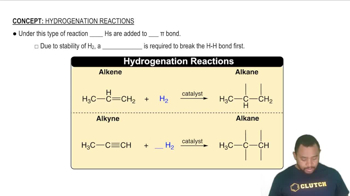
Process where hydrogen atoms are added across pi bonds in unsaturated hydrocarbons, converting them into saturated compounds.
Track progress
Control buttons has been changed to "navigation" mode.
1/15
Related practice
Recommended videos
Guided course
1:22
Hydrogenation Reactions Concept 1
Jules
1912
views
5
rank
Guided course
0:49
Hydrogenation Reactions Example 1
Jules
1612
views
5
rank
Terms in this set (15)
Hide definitions
Hydrogenation
Process where hydrogen atoms are added across pi bonds in unsaturated hydrocarbons, converting them into saturated compounds.
Pi Bond
Type of covalent bond found in alkenes and alkynes, targeted and broken during the addition of hydrogen atoms.
Alkene
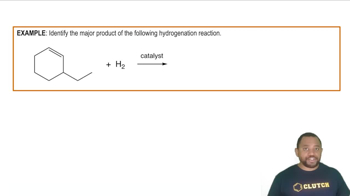
Hydrocarbon containing one double bond, which reacts with hydrogen in the presence of a catalyst to form a saturated product.
Alkyne
Hydrocarbon with two pi bonds, requiring two moles of hydrogen for complete conversion to a saturated compound.
Catalyst
Substance, often a metal, that enables the breaking of the hydrogen-hydrogen bond, facilitating the reaction without being consumed.
Alkane
Fully saturated hydrocarbon product of hydrogenation, containing only single bonds between carbon and hydrogen atoms.
Saturation
State achieved when all carbon-carbon bonds in a hydrocarbon are single, resulting from the addition of hydrogen atoms.
Metal Catalyst
Commonly used element in hydrogenation, essential for activating molecular hydrogen and enabling its addition to unsaturated bonds.
Double Bond
Bond involving two shared pairs of electrons between carbons, broken during hydrogenation to allow hydrogen addition.
Mole
Unit representing the amount of hydrogen required per pi bond in the substrate during the reaction.
Unsaturated Hydrocarbon
Molecule containing one or more pi bonds, which can undergo hydrogenation to become fully saturated.
Single Bond
Bond type present in the final product of hydrogenation, indicating complete saturation of the hydrocarbon.
Hydrogen-Hydrogen Bond
Strong covalent linkage in molecular hydrogen that must be broken by a catalyst for the reaction to proceed.
Product
Resulting compound after hydrogenation, always a saturated hydrocarbon with only single bonds.
Reagent
Substance, specifically molecular hydrogen, consumed during the reaction to achieve saturation of the substrate.