Back

Intro to Haworth Projections definitions

Control buttons has been changed to "navigation" mode.
1/14
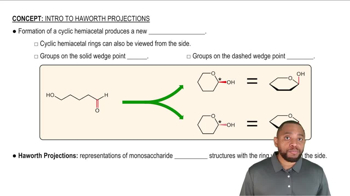
  • Cyclic Hemiacetal

    A six-membered ring structure formed by an intramolecular reaction between an aldehyde and an alcohol within the same molecule.
  • Chiral Center

    A carbon atom in the ring bonded to four different groups, giving rise to two possible spatial arrangements.
  • Intramolecular Reaction

    A chemical process where functional groups within the same molecule react to form a ring structure.
  • Aldehyde

    A functional group containing a carbonyl carbon, serving as the starting point for ring formation in monosaccharides.
  • Alcohol

    A functional group with an -OH group that reacts with an aldehyde to form a cyclic structure.
  • Carbonyl Carbon

    The specific carbon atom in an aldehyde that initiates ring numbering and participates in ring closure.
  • Six-Membered Ring

    A cyclic structure containing six atoms, typically five carbons and one oxygen, formed during hemiacetal creation.
  • Oxygen Incorporation

    The inclusion of an oxygen atom within the ring, distinguishing the cyclic structure from open-chain forms.
  • Wedged Bond

    A solid triangular line in diagrams indicating a group is oriented above the plane of the ring.
  • Dashed Bond

    A broken line in diagrams showing a group is oriented below the plane of the ring.
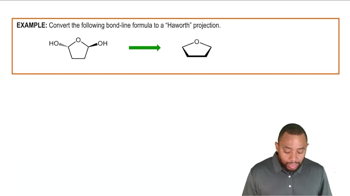
  • Haworth Projection

    A side-view diagram of a cyclic monosaccharide, illustrating the spatial orientation of groups around the ring.
  • Monosaccharide

    A simple sugar molecule that can cyclize to form a ring structure represented in Haworth projections.
  • Stereochemistry

    The study of spatial arrangements of atoms, especially the orientation of groups at the chiral center in rings.
  • Base Structure

    A simplified cyclic form used to understand group orientation before adding all bonds and substituents.