Skip to main content
GOB Chemistry
My Course
Learn
Exam Prep
AI Tutor
Study Guides
Textbook Solutions
Flashcards
Explore
Try the app
My Course
Learn
Exam Prep
AI Tutor
Study Guides
Textbook Solutions
Flashcards
Explore
Try the app
Back
Intro to Lipids quiz
You can tap to flip the card.
What is the origin of the word 'lipid'?
You can tap to flip the card.
👆
What is the origin of the word 'lipid'?
The word 'lipid' is derived from the Greek word 'lipo,' which means fat.
Track progress
Control buttons has been changed to "navigation" mode.
1/15
Related flashcards
Related practice
Recommended videos
Intro to Lipids definitions
Intro to Lipids
15 Terms
Intro to Lipids
23. Lipids
1 problem
Topic
Nicole
Fatty Acids
23. Lipids
7 problems
Topic
Ernest
23. Lipids - Part 1 of 3
6 topics
13 problems
Chapter
Ernest
23. Lipids - Part 2 of 3
6 topics
12 problems
Chapter
Nicole
23. Lipids - Part 3 of 3
1 topic
3 problems
Chapter
Guided course
3:36
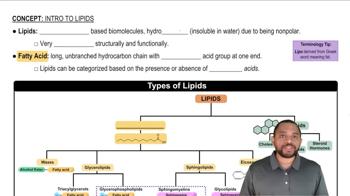
Intro to Lipids Concept 1
2818
views
9
rank
Guided course
1:28
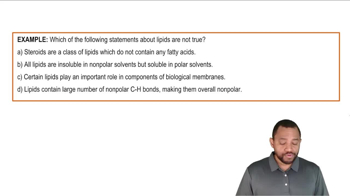
Intro to Lipids Example 1
2661
views
16
rank
Guided course
1:09
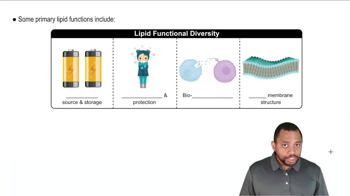
Intro to Lipids Concept 2
2658
views
5
rank
Terms in this set (15)
Hide definitions
What is the origin of the word 'lipid'?
The word 'lipid' is derived from the Greek word 'lipo,' which means fat.
What is the main chemical characteristic of lipids?
Lipids are hydrophobic and nonpolar, making them insoluble in water.
How are lipids structurally categorized?
Lipids are categorized based on the presence or absence of fatty acids.
What are the main subgroups of steroids?
Steroids are divided into cholesterol, bile acids, and steroid hormones.
What is the basic structure of a fatty acid?
A fatty acid is a long hydrocarbon chain with a carboxylic acid at one end.
What are waxes composed of?
Waxes are esters formed from an alcohol and a fatty acid.
What is a triacylglycerol?
A triacylglycerol is a glycerol molecule with three fatty acid chains attached.
What do glycerophospholipids and sphingomyelins have in common?
Both contain a phosphate group and an amino alcohol.
What is the base structure of glycolipids?
Glycolipids have a sphingosine base, a fatty acid, and a sugar component.
What distinguishes eicosanoids from other lipids?
Eicosanoids have long carbon chains with unsaturated bonds and a carboxylic acid end.
What is one primary function of lipids related to energy?
Lipids serve as a source of energy and are used for energy storage.
How do lipids contribute to insulation?
Lipids provide insulation and protection, helping to keep organisms warm.
What role do lipids play in biosignaling?
Lipids are involved in biosignaling, allowing communication between biomolecules.
How are lipids involved in cell membranes?
Lipids form integral parts of cell membranes, aiding in nutrient transport and ion passage.
What is the main difference between glycerophospholipids and sphingomyelins?
Glycerophospholipids have a glycerol backbone and an additional fatty acid, while sphingomyelins have a sphingosine base.
 BackBack

 3:36
3:36