Back

Intro to Metabolism definitions

Control buttons has been changed to "navigation" mode.
1/15
  • Metabolism

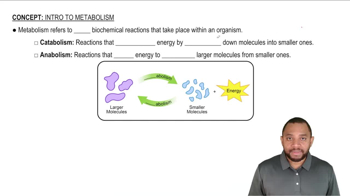
    Sum of all biochemical reactions within an organism, encompassing both energy-releasing and energy-consuming processes.
  • Catabolism

    Process involving breakdown of complex molecules into simpler ones, resulting in the release of energy.
  • Anabolism

    Process where smaller molecules are combined to form larger ones, requiring an input of energy.
  • Metabolic Pathway

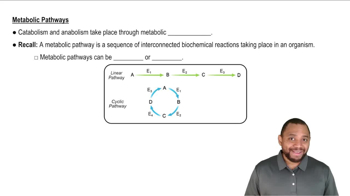
    Sequence of interconnected biochemical reactions, which can be linear or cyclic, facilitating metabolic processes.
  • Digestion

    Initial stage where proteins, carbohydrates, and lipids are broken down into amino acids, monosaccharides, and fatty acids.
  • Amino Acids

    Building blocks produced from protein breakdown during the first stage of food catabolism.
  • Monosaccharides

    Simple sugars resulting from carbohydrate breakdown in the digestive process.
  • Fatty Acids

    Molecules generated from lipid breakdown, serving as substrates for further metabolic processing.
  • Acetyl CoA

    Central molecule formed after digestion, entering the citric acid cycle for further energy extraction.
  • Citric Acid Cycle

    Cyclic series of reactions where Acetyl CoA is oxidized, producing electron carriers and carbon dioxide.
  • Electron Transport Chain

    Series of protein complexes transferring electrons to generate a proton gradient for ATP synthesis.
  • Oxidative Phosphorylation

    Process coupling electron transport to ATP production, utilizing oxygen as the final electron acceptor.
  • ATP

    Primary energy currency produced during catabolic reactions, especially in the final stages of metabolism.
  • Common Metabolic Pathway

    Shared sequence of reactions in stages 3 and 4, identical for all food types after initial breakdown.
  • Aerobic Respiration

    Predominant energy-producing pathway in the presence of oxygen, involving all four stages of food catabolism.