Back

Introduction to Translation definitions

Control buttons has been changed to "navigation" mode.
1/14
  • Translation

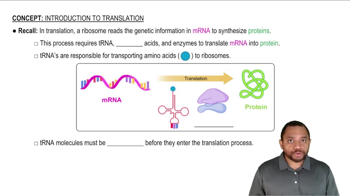
    Process where ribosomes use mRNA as a template to assemble amino acids into proteins with the help of tRNA and enzymes.
  • Ribosome

    Molecular machine composed of proteins and RNA that facilitates the decoding of mRNA into a polypeptide chain.
  • mRNA

    Single-stranded nucleic acid carrying genetic instructions from DNA to the ribosome for protein synthesis.
  • tRNA

    Adapter molecule with an anticodon and acceptor stem, responsible for delivering specific amino acids to the ribosome.
  • Amino Acid

    Building block of proteins, each with a unique side chain, linked together during translation to form polypeptides.
  • Anticodon

    Three-nucleotide sequence on tRNA that pairs with a complementary codon on mRNA during translation.
  • Acceptor Stem

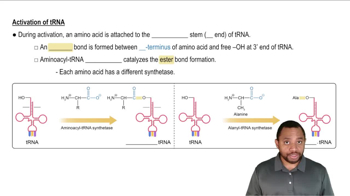
    3' end region of tRNA where an amino acid is covalently attached during activation.
  • Ester Bond

    Covalent linkage formed between the carboxyl group of an amino acid and the hydroxyl group at the 3' end of tRNA.
  • Aminoacyl tRNA Synthetase

    Enzyme that catalyzes the attachment of a specific amino acid to its corresponding tRNA, ensuring translation accuracy.
  • Protein Synthesis

    Cellular process of assembling amino acids into polypeptides based on the sequence encoded in mRNA.
  • C Terminus

    Carboxyl end of an amino acid or polypeptide, involved in forming an ester bond with tRNA during activation.
  • 3' End

    Terminal region of tRNA containing a free hydroxyl group, serving as the attachment site for amino acids.
  • Cloverleaf Structure

    Characteristic secondary shape of tRNA, featuring loops and stems, crucial for its function in translation.
  • Activation

    Preparatory step where an amino acid is enzymatically linked to tRNA, enabling its participation in translation.