Back

Introduction to Translation quiz

Control buttons has been changed to "navigation" mode.
1/15
  • What is the main function of translation in cells?

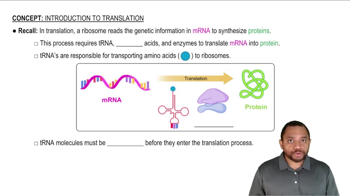
    Translation converts mRNA into protein using ribosomes, tRNA, amino acids, and enzymes.
  • Which molecules are required for translation to occur?

    Translation requires tRNA, amino acids, ribosomes, and enzymes.
  • What role does tRNA play during translation?

    tRNA transports amino acids to the ribosome for protein synthesis.
  • Where is the amino acid attached on a tRNA molecule?

    The amino acid is attached to the acceptor stem at the 3' end of tRNA.
  • What is the structure of tRNA commonly described as?

    tRNA is often described as having a cloverleaf structure.
  • What must happen to tRNA before it participates in translation?

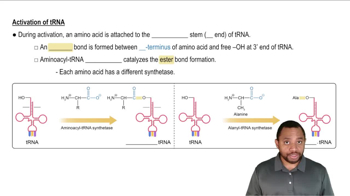
    tRNA must be activated by attaching an amino acid to its 3' end.
  • What type of bond forms between the amino acid and tRNA during activation?

    An ester bond forms between the C-terminus of the amino acid and the hydroxyl group at the 3' end of tRNA.
  • Which enzyme catalyzes the attachment of an amino acid to tRNA?

    Aminoacyl tRNA synthetase catalyzes the formation of the ester bond.
  • How is the enzyme that activates tRNA named generically?

    The generic name is aminoacyl tRNA synthetase.
  • How does the enzyme name change for a specific amino acid?

    The enzyme name uses the amino acid root with 'yl' (e.g., alanyl tRNA synthetase for alanine).
  • What is the function of the anticodon region of tRNA?

    The anticodon region pairs with the corresponding codon on mRNA during translation.
  • What is the significance of the 3' end of tRNA?

    The 3' end is where the amino acid is attached during tRNA activation.
  • What is the product called when a specific amino acid is attached to tRNA?

    It is called, for example, alanyl tRNA when alanine is attached.
  • How many different aminoacyl tRNA synthetases exist?

    There are 20 different synthetases, one for each amino acid.
  • Why is tRNA activation important for protein synthesis?

    Activation ensures that tRNA carries the correct amino acid for incorporation into the growing protein chain.