Skip to main content
GOB Chemistry
My Course
Learn
Exam Prep
AI Tutor
Study Guides
Textbook Solutions
Flashcards
Explore
Try the app
My Course
Learn
Exam Prep
AI Tutor
Study Guides
Textbook Solutions
Flashcards
Explore
Try the app
Back
Ionic Salts (Simplified) definitions
You can tap to flip the card.
Salt
You can tap to flip the card.
👆
Salt
Ionic compound formed as a product of acid-base neutralization, consisting of a cation and an anion.
Track progress
Control buttons has been changed to "navigation" mode.
1/15
Related flashcards
Related practice
Recommended videos
Ionic Salts (Simplified) quiz
Ionic Salts (Simplified)
15 Terms
Ionic Salts (Simplified)
10. Acids and Bases
5 problems
Topic
Buffers
10. Acids and Bases
5 problems
Topic
Jules
10. Acids and Bases - Part 1 of 3
6 topics
15 problems
Chapter
Jules
10. Acids and Bases - Part 2 of 3
8 topics
13 problems
Chapter
Jules
10. Acids and Bases - Part 3 of 3
1 topic
3 problems
Chapter
Guided course
01:20
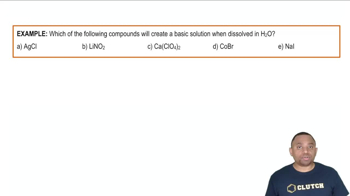
Basic Solution Example
2568
views
6
rank
Guided course
01:53
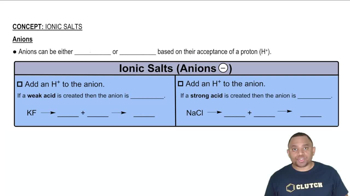
Anion Acidity and Basicity
2816
views
6
rank
Guided course
00:50
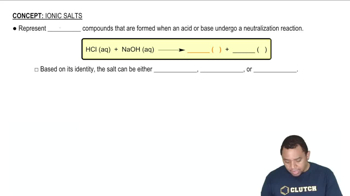
Ionic Salts
3062
views
9
rank
Terms in this set (15)
Hide definitions
Salt
Ionic compound formed as a product of acid-base neutralization, consisting of a cation and an anion.
Cation
Positively charged ion in a salt, often determining the acidic or neutral nature of the compound.
Anion
Negatively charged ion in a salt, whose properties influence whether the salt is basic or neutral.
Transition Metal
Element found in the central block of the periodic table, forming cations that can be acidic if charge is +2 or higher.
Main Group Metal
Element from groups 1A to 4A, forming cations that are acidic only if charge is +3 or higher.
Positive Amine
Nitrogen-containing ion with a positive charge, always contributing acidity to a salt.
Neutralization
Reaction between an acid and a base producing water and an ionic compound.
Oxyacid
Acid containing hydrogen, oxygen, and another element; strength depends on the oxygen-to-hydrogen ratio.
Binary Acid
Acid composed of hydrogen and one other nonmetal element, lacking oxygen.
Conjugate Base
Species formed when an acid donates a proton, its strength relates inversely to the acid's strength.
Group 1A Metal
Element from the first column of the periodic table, always forming neutral cations in salts.
Group 2A Metal
Element from the second column of the periodic table, always forming neutral cations in salts.
Polyatomic Ion
Charged species composed of multiple atoms, often found as anions in salts.
Solubility Rule
Guideline predicting whether an ionic compound will dissolve in water, affecting salt dissociation.
Charge Threshold
Minimum positive charge required on a metal cation for the salt to exhibit acidic properties.
 BackBack
 01:20
01:20