GOB Chemistry
My Course
Learn
Exam Prep
AI Tutor
Study Guides
Textbook Solutions
Flashcards
Explore
My Course
Learn
Exam Prep
AI Tutor
Study Guides
Textbook Solutions
Flashcards
Explore
Back
Isomers definitions
You can tap to flip the card.
Define:
Isomer
You can tap to
flip the card.
👆
Isomer
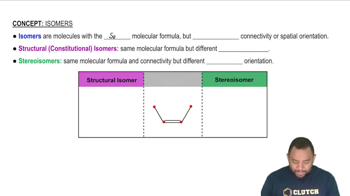
Molecule sharing a molecular formula with others but differing in atom connectivity or spatial arrangement.
Track progress
Control buttons has been changed to "navigation" mode.
1/14
Related practice
Recommended videos
Guided course
2:16
Isomers Concept 1
Jules
2073
views
7
rank
Guided course
1:56
Stereoisomers Concept 2
Jules
1944
views
3
rank
Guided course
3:05
Types of Isomers Concept 3
Jules
1974
views
7
rank
Terms in this set (14)
Hide definitions
Isomer
Molecule sharing a molecular formula with others but differing in atom connectivity or spatial arrangement.
Molecular Formula
Representation showing the number and type of atoms present in a molecule, without indicating arrangement.
Connectivity
Order in which atoms are linked together within a molecule, determining its structure.
Structural Isomer
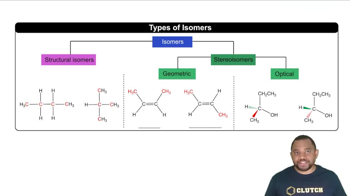
Compound with identical molecular formula as another but distinct atom-to-atom connections.
Constitutional Isomer
Alternative term for a molecule with the same molecular formula but different atom connectivity.
Stereoisomer
Compound with identical molecular formula and connectivity as another but differing in three-dimensional arrangement.
Geometric Isomer
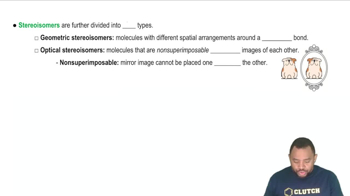
Molecule differing from another in spatial arrangement around a double bond, often described as cis or trans.
Optical Isomer
Non-superimposable mirror image molecule, distinguishable by its inability to align perfectly with its counterpart.
Cis Isomer
Form where similar groups are positioned on the same side of a double bond within a molecule.
Trans Isomer
Form where similar groups are positioned on opposite sides of a double bond within a molecule.
Spatial Orientation
Three-dimensional positioning of atoms or groups within a molecule, affecting its isomeric form.
Double Bond
Chemical feature involving two shared pairs of electrons between atoms, restricting rotation and enabling geometric isomerism.
Mirror Image
Arrangement where a molecule appears as a reflection of another, often used to identify optical isomers.
Non-superimposable
Characteristic where two objects cannot be perfectly aligned, even when overlaid, as seen in optical isomers.