Skip to main content
GOB Chemistry
My Course
Learn
Exam Prep
AI Tutor
Study Guides
Textbook Solutions
Flashcards
Explore
Try the app
My Course
Learn
Exam Prep
AI Tutor
Study Guides
Textbook Solutions
Flashcards
Explore
Try the app
Back
Kinetic Molecular Theory definitions
You can tap to flip the card.
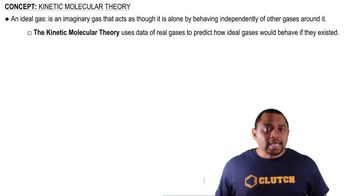
Ideal Gas
You can tap to flip the card.
👆
Ideal Gas
A theoretical substance imagined to behave independently, unaffected by other gases, and used to model real gas behavior.
Track progress
Control buttons has been changed to "navigation" mode.
1/15
Related flashcards
Related practice
Recommended videos
Kinetic Molecular Theory quiz
Kinetic Molecular Theory
15 Terms
Kinetic Molecular Theory
8. Gases, Liquids and Solids
4 problems
Topic
Jules
The Ideal Gas Law
8. Gases, Liquids and Solids
4 problems
Topic
Jules
8. Gases, Liquids and Solids - Part 1 of 2
8 topics
15 problems
Chapter
Jules
8. Gases, Liquids and Solids - Part 2 of 2
7 topics
15 problems
Chapter
Jules
Guided course
02:13
Kinetic Molecular Theory Example 1
5788
views
30
rank
Guided course
01:19
Kinetic Molecular Theory Concept 1
6344
views
39
rank
Guided course
03:23
Kinetic Molecular Theory Concept 2
6272
views
33
rank
Terms in this set (15)
Hide definitions
Ideal Gas
A theoretical substance imagined to behave independently, unaffected by other gases, and used to model real gas behavior.
Kinetic Molecular Theory
A framework using real gas data to predict the properties and behavior of an imaginary, perfectly behaving gas.
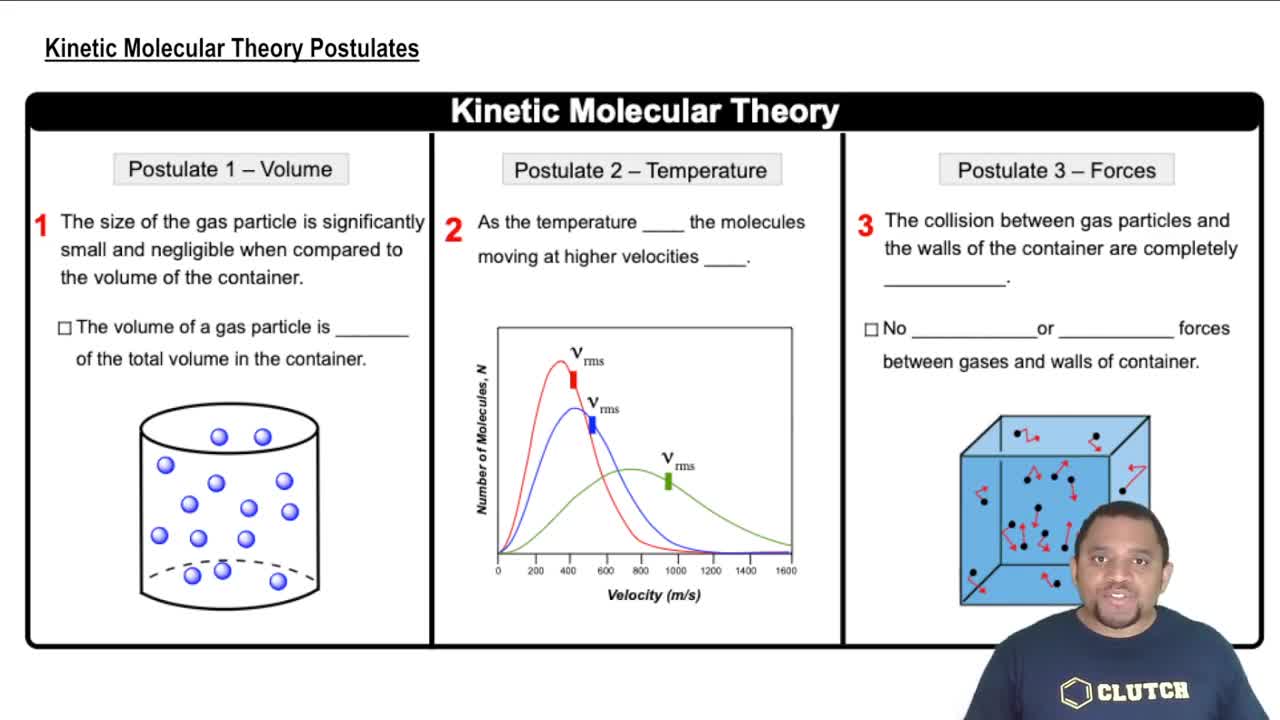
Postulate 1
A principle stating that the size of each particle is so small compared to the container that its volume is negligible.
Postulate 2
A principle describing how increased temperature leads to higher velocities for gas molecules.
Postulate 3
A principle stating that collisions between particles and container walls are perfectly elastic, with no energy loss.
Elastic Collision
An interaction where particles bounce off each other or walls without any attractive or repulsive forces or energy loss.
Root Mean Square Speed
A statistical measure representing the average velocity of gas molecules at a given temperature.
Gas Molecule
A tiny particle that moves rapidly and randomly, occupying a negligible fraction of the container's volume.
Container Volume
The total space available for gas particles, vastly larger than the combined size of all particles inside.
Temperature
A physical quantity that directly influences the average speed and kinetic energy of gas particles.
Velocity
The speed and direction at which a gas particle moves, increasing with higher temperature.
Attractive Forces
Interactions that would cause particles to stick together, assumed absent in the ideal gas model.
Repulsive Forces
Interactions that would push particles apart, considered nonexistent in the context of ideal gases.
Stoichiometry
The calculation of quantitative relationships in chemical reactions, often involving gas laws.
Imaginary Gas
A conceptual substance used for theoretical modeling, not found in reality but useful for predictions.
 BackBack
 02:13
02:13