Skip to main content
GOB Chemistry
My Course
Learn
Exam Prep
AI Tutor
Study Guides
Textbook Solutions
Flashcards
Explore
Try the app
My Course
Learn
Exam Prep
AI Tutor
Study Guides
Textbook Solutions
Flashcards
Explore
Try the app
Back
Kinetic Molecular Theory quiz
You can tap to flip the card.
What is an ideal gas according to kinetic molecular theory?
You can tap to flip the card.
👆
What is an ideal gas according to kinetic molecular theory?
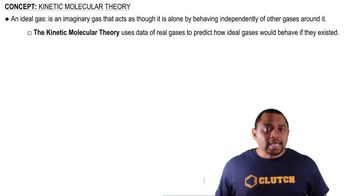
An ideal gas is an imaginary gas that behaves as if it is alone and is not influenced by other gases around it.
Track progress
Control buttons has been changed to "navigation" mode.
1/15
Related flashcards
Related practice
Recommended videos
Kinetic Molecular Theory definitions
Kinetic Molecular Theory
15 Terms
Kinetic Molecular Theory
8. Gases, Liquids and Solids
4 problems
Topic
Jules
The Ideal Gas Law
8. Gases, Liquids and Solids
4 problems
Topic
Jules
8. Gases, Liquids and Solids - Part 1 of 2
8 topics
15 problems
Chapter
Jules
8. Gases, Liquids and Solids - Part 2 of 2
7 topics
15 problems
Chapter
Jules
Guided course
02:13
Kinetic Molecular Theory Example 1
5792
views
30
rank
Guided course
01:19
Kinetic Molecular Theory Concept 1
6346
views
39
rank
Guided course
03:23
Kinetic Molecular Theory Concept 2
6273
views
33
rank
Terms in this set (15)
Hide definitions
What is an ideal gas according to kinetic molecular theory?
An ideal gas is an imaginary gas that behaves as if it is alone and is not influenced by other gases around it.
How does the kinetic molecular theory use real gases?
It uses data from real gases to predict how ideal gases would behave if they existed.
What does the first postulate of kinetic molecular theory state about gas particle volume?
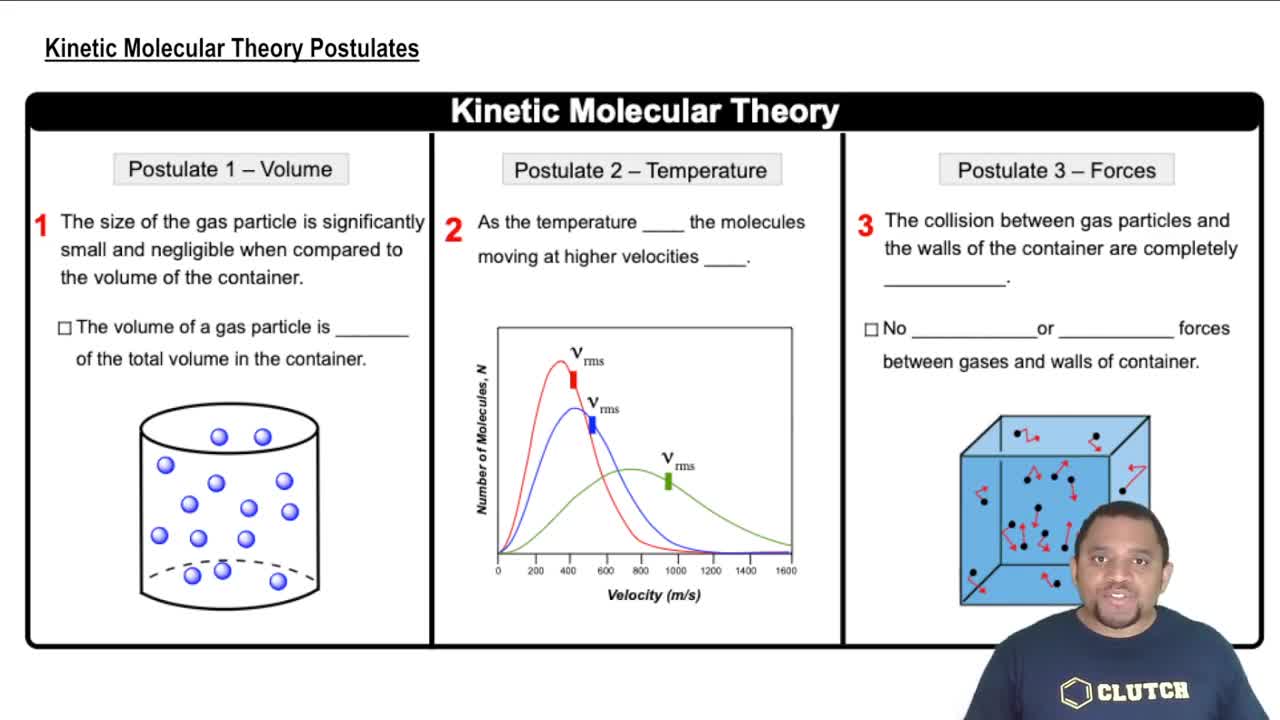
It states that the volume of gas particles is negligible compared to the container's volume, representing less than 0.01% of the total volume.
Why is the volume of individual gas particles considered negligible?
Because each gas particle is so small that its volume is not important compared to the total volume of the container.
What does the second postulate of kinetic molecular theory relate to?
It relates to temperature, stating that as temperature increases, the velocity of gas molecules also increases.
How does temperature affect the velocity of gas molecules?
As temperature increases, the root mean square speed and velocity of gas molecules increase.
What is meant by 'root mean square speed' in the context of gases?
It is a measure of the average speed of gas molecules at a given temperature.
What does the third postulate of kinetic molecular theory state about collisions?
It states that collisions between gas particles and the container walls are elastic, with no attractive or repulsive forces.
What is an elastic collision in the context of ideal gases?
An elastic collision means that gas particles bounce off each other and the container walls without losing energy or sticking together.
How do ideal gas particles interact with each other according to the theory?
They do not experience any attractive or repulsive forces and behave independently.
Why are ideal gases considered imaginary?
Because no real gas perfectly follows all the assumptions of the kinetic molecular theory.
How does the kinetic molecular theory help us understand gas laws?
It provides a model to explain and predict the behavior of gases under different conditions.
What analogy is used to describe elastic collisions of gas particles?
The analogy of ping pong balls bouncing in a container is used to describe elastic collisions.
Do real gases always behave like ideal gases?
No, real gases can have interactions and do not always behave ideally, especially under high pressure or low temperature.
What is the main purpose of the kinetic molecular theory?
Its main purpose is to model and predict the behavior of gases, especially ideal gases, using data from real gases.
 BackBack
 02:13
02:13