What is the main purpose of membrane transport in cells?
Membrane transport allows cells to exchange essential substances and expel waste products with the extracellular fluid.
What are the two broad categories of membrane transport mechanisms?
The two categories are passive transport and active transport.
How does passive transport differ from active transport?
Passive transport does not require energy and moves substances down the concentration gradient, while active transport requires energy and moves substances against the concentration gradient.
What is a concentration gradient?
A concentration gradient is the difference in concentration of a substance over a distance.
What are the two types of passive transport?
The two types are simple diffusion and facilitated diffusion.
Which molecules typically move across the membrane by simple diffusion?
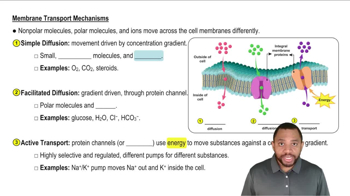
Small, non-polar molecules and water, such as oxygen, CO2, and steroids, move by simple diffusion.
How do molecules move during simple diffusion?
Molecules move directly through the lipid bilayer from areas of higher to lower concentration.
What is facilitated diffusion?
Facilitated diffusion is the movement of polar molecules and ions across the membrane through a protein channel, driven by the concentration gradient.
Which substances use facilitated diffusion to cross the cell membrane?
Glucose, water, chloride ion, and bicarbonate use facilitated diffusion.
What role do integral proteins play in facilitated diffusion?
Integral proteins form channels that allow specific molecules to pass through the membrane.
What is required for active transport to occur?
Active transport requires energy, usually in the form of ATP, to move substances against the concentration gradient.
How is active transport different from facilitated diffusion?
Active transport uses energy and moves substances against the gradient, while facilitated diffusion does not require energy and moves substances down the gradient.
What is an example of active transport in cells?
The sodium-potassium pump, which moves sodium out and potassium into the cell, is an example of active transport.
Why is active transport considered highly selective and regulated?
Active transport uses specific protein pumps for different substances and is tightly controlled by the cell.
What types of molecules are transported by active transport mechanisms?
Ions such as sodium and potassium are transported by active transport mechanisms.
 Back
Back

 0:53
0:53