GOB Chemistry
My Course
Learn
Exam Prep
AI Tutor
Study Guides
Textbook Solutions
Flashcards
Explore
My Course
Learn
Exam Prep
AI Tutor
Study Guides
Textbook Solutions
Flashcards
Explore
Back
Mutarotation definitions
You can tap to flip the card.
Define:
Mutarotation
You can tap to
flip the card.
👆
Mutarotation
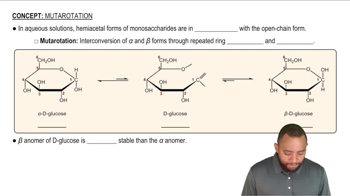
Interconversion between two cyclic forms of a sugar via ring opening and closing in aqueous solution.
Track progress
Control buttons has been changed to "navigation" mode.
1/14
Related practice
Recommended videos
Guided course
2:10
Mutarotation Concept 1
Jules
1751
views
3
rank
Guided course
1:10
Mutarotation Example 1
Jules
1829
views
2
rank
Terms in this set (14)
Hide definitions
Mutarotation
Interconversion between two cyclic forms of a sugar via ring opening and closing in aqueous solution.
Monosaccharide
Simple sugar molecule that can exist in both cyclic and open chain forms in water.
D-Glucose
A common monosaccharide that displays equilibrium between alpha, beta, and open chain forms in solution.
Alpha Form
Cyclic structure of a sugar where the anomeric hydroxyl group is positioned opposite to the CH2OH group.
Beta Form
Cyclic structure of a sugar where the anomeric hydroxyl group is on the same side as the CH2OH group.
Open Chain Form
Linear structure of a sugar featuring an aldehyde group at carbon one, less stable than cyclic forms.
Aqueous Solution
Water-based environment where sugars can shift between cyclic and open chain structures.
Hemiacetal Carbon
Carbon atom in a sugar ring formed by reaction between an aldehyde group and a hydroxyl group.
Anomeric Carbon
Carbon atom in a sugar ring that determines the alpha or beta configuration after ring closure.
Equilibrium
State where different forms of a sugar coexist in fixed proportions in solution.
Aldehyde Group
Functional group with a carbon double-bonded to oxygen and single-bonded to hydrogen, present in open chain sugars.
Ring Opening
Process where a cyclic sugar structure converts to its linear form, exposing the aldehyde group.
Ring Closing
Process where a linear sugar structure forms a ring, creating a new chiral center at the anomeric carbon.
Stability
Relative tendency of a sugar form to persist in solution, with beta being most and open chain least.