Back

Naming Other Substituents definitions

Control buttons has been changed to "navigation" mode.
1/14
  • Alkyl Halide

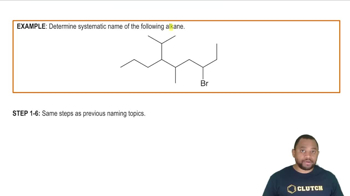
    A compound featuring an alkyl group bonded directly to a halogen atom, commonly named by specifying the halogen as a substituent.
  • Halogen

    An element from Group 17, such as Fluorine, Chlorine, Bromine, or Iodine, often attached to carbon chains in organic molecules.
  • Substituent

    An atom or group replacing a hydrogen on a parent chain, requiring a specific name and position in organic nomenclature.
  • Fluoro

    The name given to a fluorine atom when it acts as a substituent on a carbon chain in organic compounds.
  • Chloro

    The term used for a chlorine atom when it is attached as a substituent to a hydrocarbon chain.
  • Bromo

    The substituent name for a bromine atom bonded to a carbon chain in organic nomenclature.
  • Iodo

    The name assigned to an iodine atom when it is present as a substituent on a parent hydrocarbon chain.
  • Parent Chain

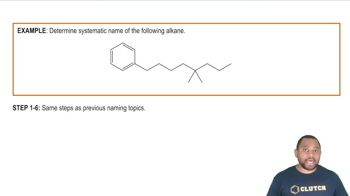
    The longest continuous carbon chain in a molecule, serving as the main framework for naming organic compounds.
  • Phenyl Group

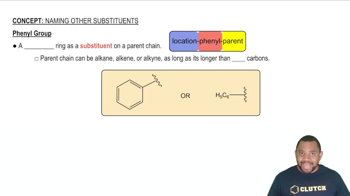
    A benzene ring missing one hydrogen, acting as a substituent on a longer carbon chain, denoted as C6H5.
  • Benzene

    A six-carbon aromatic ring with alternating double bonds, formula C6H6, serving as the basis for the phenyl group.
  • Skeletal Formula

    A structural representation showing the arrangement of atoms in a molecule, emphasizing bonds and omitting most hydrogens.
  • Alkane

    A saturated hydrocarbon chain containing only single bonds between carbon atoms.
  • Alkene

    A hydrocarbon chain featuring at least one carbon-carbon double bond.
  • Alkyne

    A hydrocarbon chain containing at least one carbon-carbon triple bond.