GOB Chemistry
My Course
Learn
Exam Prep
AI Tutor
Study Guides
Textbook Solutions
Flashcards
Explore
My Course
Learn
Exam Prep
AI Tutor
Study Guides
Textbook Solutions
Flashcards
Explore
Back
Osmolarity quiz
You can tap to flip the card.
Define:
What does osmolarity measure in a solution?
You can tap to flip the card.
👆
What does osmolarity measure in a solution?
Osmolarity measures the number of moles of ions per liter of solution.
Track progress
Control buttons has been changed to "navigation" mode.
1/15
Related flashcards
Related practice
Recommended videos
Osmolarity definitions
Osmolarity
13 Terms
Osmolarity
9. Solutions
3 problems
Topic

Jules
Parts per Million (ppm)
9. Solutions
1 problem
Topic
Jules
9. Solutions - Part 1 of 3
5 topics
12 problems
Chapter
Jules
9. Solutions - Part 2 of 3
7 topics
11 problems
Chapter
Jules
9. Solutions - Part 3 of 3
7 topics
11 problems
Chapter
Jules
Guided course
01:10
Osmolarity
Jules
7423
views
35
rank
Guided course
02:55
Osmolarity Example 1
Jules
6796
views
40
rank
Guided course
00:37
Osmolarity
Jules
6116
views
24
rank
Terms in this set (15)
Hide definitions
What does osmolarity measure in a solution?
Osmolarity measures the number of moles of ions per liter of solution.
How is osmolarity similar to molarity?
Both osmolarity and molarity are measured in moles per liter, but osmolarity focuses on ions while molarity focuses on solute.
What is the formula for calculating osmolarity using method 1?
Osmolarity = moles of ions / liters of solution.
What type of solutes does osmolarity specifically consider?
Osmolarity specifically considers solutes that are ions, meaning they have charges.
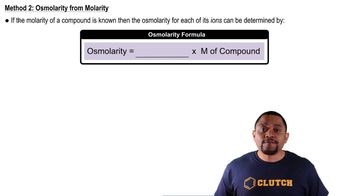
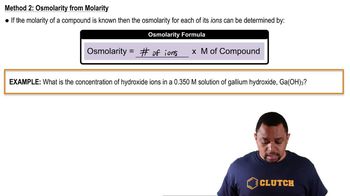
How does method 2 calculate osmolarity?
Method 2 calculates osmolarity by multiplying the number of ions in a compound by the molarity of the compound.
If you know the molarity of a compound, what else do you need to calculate osmolarity using method 2?
You need to know the number of ions the compound dissociates into.
What is another name for osmolarity mentioned in the lesson?
Osmolarity is sometimes referred to as ionic molarity.
What is the unit for osmolarity?
The unit for osmolarity is moles of ions per liter (mol/L).
Why is osmolarity important in chemistry?
Osmolarity is important because it helps quantify the concentration of ions in a solution, which affects chemical and biological processes.
What is the main difference between molarity and osmolarity?
Molarity measures moles of solute per liter, while osmolarity measures moles of ions per liter.
What do you divide by in the formula for osmolarity using method 1?
You divide the moles of ions by the liters of solution.
If a compound dissociates into three ions and has a molarity of 2 M, what is its osmolarity?
Its osmolarity is 6 osmoles per liter (3 ions x 2 M = 6 osmoles/L).
What must a solute have to be considered in osmolarity calculations?
The solute must dissociate into ions in solution.
What is the first step in method 1 for calculating osmolarity?
The first step is to determine the total moles of ions present in the solution.
How can you use the number of ions in a compound to find osmolarity?
Multiply the number of ions the compound produces by its molarity to get the osmolarity.