GOB Chemistry
My Course
Learn
Exam Prep
AI Tutor
Study Guides
Textbook Solutions
Flashcards
Explore
My Course
Learn
Exam Prep
AI Tutor
Study Guides
Textbook Solutions
Flashcards
Explore
Back
Periodic Trend: Ranking Ionic Radii definitions
You can tap to flip the card.
Define:
Ionic Radius
You can tap to flip the card.
👆
Ionic Radius
Distance from the nucleus to the outermost electron in an ion, influenced by electron count and ionic charge.
Track progress
Control buttons has been changed to "navigation" mode.
1/15
Related flashcards
Related practice
Recommended videos
Periodic Trend: Ranking Ionic Radii quiz
Periodic Trend: Ranking Ionic Radii
15 Terms
Periodic Trend: Ionization Energy (Simplified)
3. Ionic Compounds
4 problems
Topic

Jules
3. Ionic Compounds - Part 1 of 2
5 topics
9 problems
Chapter
Jules
3. Ionic Compounds - Part 2 of 2
6 topics
9 problems
Chapter
Jules
Guided course
03:07
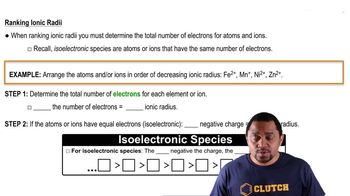
Periodic Trend: Ranking Ionic Radii Concept 1
Jules
4610
views
24
rank
Terms in this set (15)
Hide definitions
Ionic Radius
Distance from the nucleus to the outermost electron in an ion, influenced by electron count and ionic charge.
Isoelectronic Species
Atoms or ions possessing identical numbers of electrons, often compared by charge to determine size differences.
Atomic Number
Unique value representing the number of protons in an atom, used to determine electron count in neutral atoms.
Electron Count
Total number of electrons present in an atom or ion, crucial for predicting relative ionic sizes.
Charge
Numerical indication of electron loss or gain in an ion, affecting ionic radius especially among isoelectronic species.
Cation
Positively charged ion formed by electron loss, typically resulting in a smaller ionic radius compared to the neutral atom.
Anion
Negatively charged ion formed by electron gain, generally exhibiting a larger ionic radius than the neutral atom.
Neutral Atom
Species with equal numbers of protons and electrons, serving as a reference for changes in ionic size.
Decreasing Order
Arrangement from largest to smallest, often used to rank ionic radii based on electron count and charge.
Positive Charge
State resulting from electron loss, leading to a reduced ionic radius among isoelectronic ions.
Negative Charge
State resulting from electron gain, causing an increase in ionic radius among isoelectronic ions.
Iron(II) Ion
Species with 24 electrons and a +2 charge, smaller than isoelectronic ions with less positive charge.
Manganese(I) Ion
Species with 24 electrons and a +1 charge, larger than isoelectronic ions with a higher positive charge.
Zinc(II) Ion
Ion with 28 electrons, possessing the largest ionic radius among the compared transition metal ions.
Nickel(II) Ion
Ion with 26 electrons, intermediate in ionic radius among the listed transition metal ions.