GOB Chemistry
My Course
Learn
Exam Prep
AI Tutor
Study Guides
Textbook Solutions
Flashcards
Explore
Try the app
My Course
Learn
Exam Prep
AI Tutor
Study Guides
Textbook Solutions
Flashcards
Explore
Try the app
Back
Periodic Trend: Ranking Ionic Radii quiz
You can tap to flip the card.
What is the first step in ranking ionic radii of atoms or ions?
You can tap to flip the card.
👆
What is the first step in ranking ionic radii of atoms or ions?
Determine the total number of electrons for each atom or ion.
Track progress
Control buttons has been changed to "navigation" mode.
1/15
Related flashcards
Related practice
Recommended videos
Periodic Trend: Ranking Ionic Radii definitions
Periodic Trend: Ranking Ionic Radii
15 Terms
Periodic Trend: Ionization Energy (Simplified)
3. Ionic Compounds
4 problems
Topic

Jules
3. Ionic Compounds - Part 1 of 2
5 topics
9 problems
Chapter
Jules
3. Ionic Compounds - Part 2 of 2
6 topics
9 problems
Chapter
Jules
Guided course
03:07
Periodic Trend: Ranking Ionic Radii Concept 1
5185
views
27
rank
Terms in this set (15)
Hide definitions
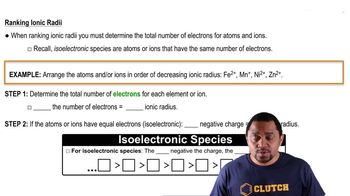
What is the first step in ranking ionic radii of atoms or ions?
Determine the total number of electrons for each atom or ion.
How does the number of electrons affect the ionic radius?
More electrons generally result in a larger ionic radius.
What are isoelectronic species?
Isoelectronic species are atoms or ions that have the same number of electrons.
When comparing isoelectronic species, what factor determines which has the larger ionic radius?
The species with the more negative charge has the larger ionic radius.
How many electrons does a neutral iron (Fe) atom have?
A neutral iron atom has 26 electrons.
How many electrons does an Fe 2+ ion have?
An Fe 2+ ion has 24 electrons.
How many electrons does a Mn+1 ion have?
A Mn+1 ion has 24 electrons.
How many electrons does a Ni 2+ ion have?
A Ni 2+ ion has 26 electrons.
How many electrons does a Zn 2+ ion have?
A Zn 2+ ion has 28 electrons.
Which ion among Fe 2+, Mn+1, Ni 2+, and Zn 2+ has the largest ionic radius?
Zn 2+ has the largest ionic radius because it has the most electrons.
Between Fe 2+ and Mn+1, which has the larger ionic radius and why?
Mn+1 has the larger ionic radius because it has a less positive charge, even though both have 24 electrons.
What is the general trend for ionic radius with respect to charge among isoelectronic species?
The more negative the charge, the larger the ionic radius.
How do you arrange ions in order of decreasing ionic radius?
List them from the one with the most electrons to the least, using charge to break ties among isoelectronic species.
If two ions have the same number of electrons, what should you compare next?
Compare their charges; the ion with the more negative (or less positive) charge is larger.
What is the order of ionic radius for the ions Zn 2+, Ni 2+, Mn+1, and Fe 2+ from largest to smallest?
Zn 2+ > Ni 2+ > Mn+1 > Fe 2+.