Back

Phosphodiester Bond Formation quiz

Control buttons has been changed to "navigation" mode.
1/15
  • What two components are involved in forming a phosphodiester bond between nucleotides?

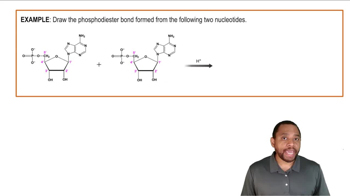
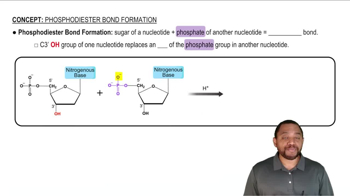
    The sugar of one nucleotide and the phosphate group of another nucleotide are involved in forming a phosphodiester bond.
  • Which carbon's OH group in a nucleotide participates in phosphodiester bond formation?

    The C 3' (3 prime) carbon's OH group of a nucleotide participates in phosphodiester bond formation.
  • What does the C 3' OH group of one nucleotide replace during phosphodiester bond formation?

    It replaces an oxygen atom in the phosphate group of another nucleotide.
  • Can any oxygen atom in the phosphate group be replaced during phosphodiester bond formation?

    Yes, any of the oxygen atoms in the phosphate group can be replaced, but typically a specific one is highlighted for explanation.
  • What is the result of the reaction between the C 3' OH group and the phosphate group?

    The result is the formation of a phosphodiester bond linking two nucleotides.
  • What is the role of the pentose ring in nucleotide structure during bond formation?

    The pentose ring provides the framework for the nucleotide, with the C 3' and C 5' carbons involved in bonding.
  • How is the nitrogenous base represented in simplified diagrams of nucleotide bonding?

    It is often represented as 'N' in a box for simplicity.
  • Which carbon of the first nucleotide is connected to its phosphate group?

    The C 5' (5 prime) carbon of the first nucleotide is connected to its phosphate group.
  • What does the phosphodiester bond connect in nucleic acids?

    It connects the 3' carbon of one nucleotide's sugar to the 5' phosphate group of the next nucleotide.
  • Why is the phosphodiester bond important in nucleic acids?

    It is crucial for linking nucleotides together, forming the backbone of nucleic acids.
  • What happens to the phosphate group after the phosphodiester bond forms?

    The phosphate group remains connected to the rest of its nucleotide, now linked to the adjacent nucleotide.
  • What is the general process described for connecting two nucleotides?

    The C 3' OH of one nucleotide reacts with the phosphate group of another, forming a phosphodiester bond.
  • What is the chemical nature of the bond formed between nucleotides?

    The bond formed is an ester bond, specifically a phosphodiester bond.
  • What is the orientation of the nucleotides when they are linked by phosphodiester bonds?

    Nucleotides are linked from the 5' end of one to the 3' end of the next.
  • What is the main takeaway from the process of phosphodiester bond formation?

    Phosphodiester bond formation links nucleotides together via the 3' OH of one and the phosphate of another, creating the backbone of nucleic acids.