GOB Chemistry
My Course
Learn
Exam Prep
AI Tutor
Study Guides
Textbook Solutions
Flashcards
Explore
My Course
Learn
Exam Prep
AI Tutor
Study Guides
Textbook Solutions
Flashcards
Explore
Back
Redox Reactions quiz
You can tap to flip the card.
Define:
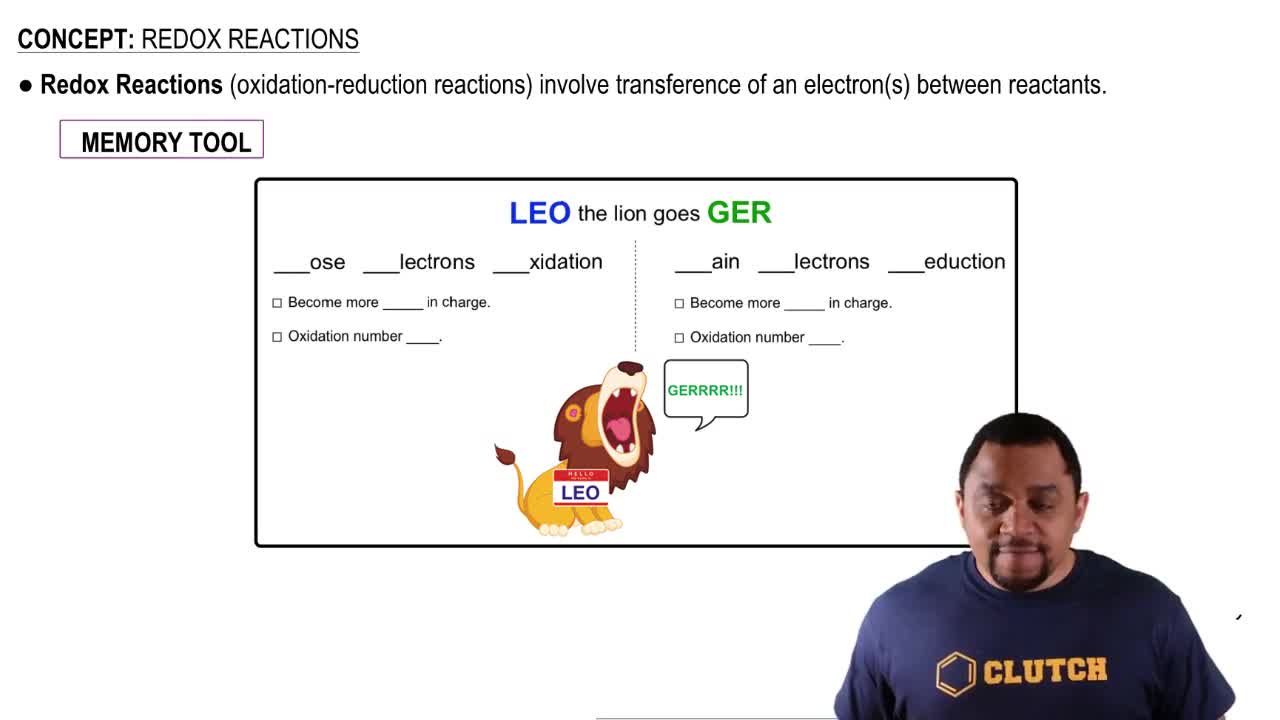
What does 'LEO' stand for in redox reactions?
You can tap to flip the card.
👆
What does 'LEO' stand for in redox reactions?
'LEO' stands for 'Lose Electrons Oxidation,' meaning a substance loses electrons and becomes more positively charged.
Track progress
Control buttons has been changed to "navigation" mode.
1/15
Related flashcards
Related practice
Recommended videos
Redox Reactions definitions
Redox Reactions
12 Terms
Redox Reactions
5. Classification & Balancing of Chemical Reactions
5 problems
Topic

Jules
5. Classification & Balancing of Chemical Reactions - Part 1 of 2
6 topics
11 problems
Chapter
Jules
5. Classification & Balancing of Chemical Reactions - Part 2 of 2
8 topics
10 problems
Chapter
Jules
Guided course
01:53
Redox Reactions
Jules
7401
views
69
rank
Guided course
01:01
Redox Reactions
Jules
6463
views
41
rank
Guided course
02:17
Redox Reactions Example 1
Jules
6644
views
49
rank
Terms in this set (15)
Hide definitions
What does 'LEO' stand for in redox reactions?
'LEO' stands for 'Lose Electrons Oxidation,' meaning a substance loses electrons and becomes more positively charged.
What does 'GER' stand for in redox reactions?
'GER' stands for 'Gain Electrons Reduction,' meaning a substance gains electrons and becomes more negatively charged.
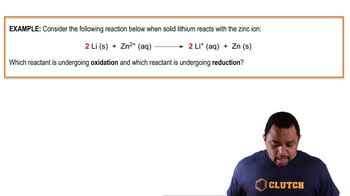
What happens to the oxidation number when a substance is oxidized?
The oxidation number increases when a substance is oxidized.
What happens to the oxidation number when a substance is reduced?
The oxidation number decreases when a substance is reduced.
How does losing electrons affect the charge of a substance?
Losing electrons makes a substance more positively charged.
How does gaining electrons affect the charge of a substance?
Gaining electrons makes a substance more negatively charged.
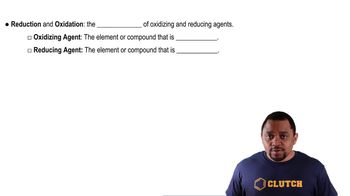
What is the role of the oxidizing agent in a redox reaction?
The oxidizing agent is the element or compound that is reduced in the reaction.
What is the role of the reducing agent in a redox reaction?
The reducing agent is the element or compound that is oxidized in the reaction.
If a substance is oxidized, what agent is it acting as?
If a substance is oxidized, it is acting as the reducing agent.
If a substance is reduced, what agent is it acting as?
If a substance is reduced, it is acting as the oxidizing agent.
What does it mean for a substance’s oxidation number to increase?
An increase in oxidation number means the substance has lost electrons and has been oxidized.
What does it mean for a substance’s oxidation number to decrease?
A decrease in oxidation number means the substance has gained electrons and has been reduced.
Why are the terms 'oxidizing agent' and 'reducing agent' considered opposites?
Because the oxidizing agent is reduced and the reducing agent is oxidized, their roles are opposite to the process they facilitate.
What memory tool can help you remember oxidation and reduction?
The phrase 'LEO the lion goes GER' helps remember that losing electrons is oxidation and gaining electrons is reduction.
How can understanding agents help solve redox reaction problems?
Knowing which substances are oxidized or reduced helps identify the oxidizing and reducing agents in redox reactions.