Back

Scientific Notation definitions

Control buttons has been changed to "navigation" mode.
1/14
  • Scientific Notation

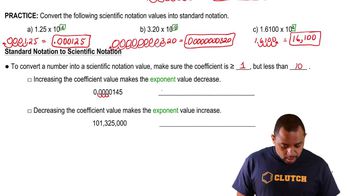
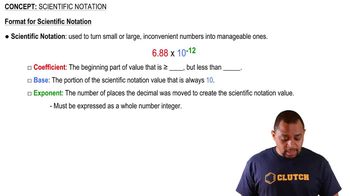
    A method for expressing very large or small numbers using a coefficient, a base of 10, and an exponent.
  • Coefficient

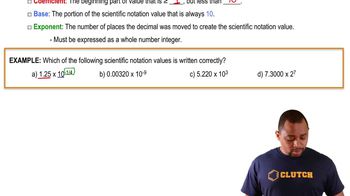
    A value between 1 and 10 that represents the significant digits in a scientific notation expression.
  • Base

    A constant value of 10 used as the foundation for the exponent in scientific notation.
  • Exponent

    A whole number indicating how many decimal places the coefficient is shifted in scientific notation.
  • Standard Notation

    The conventional way of writing numbers without exponents or special formatting.
  • Decimal Point

    A symbol used to separate the whole number part from the fractional part in a number.
  • Power

    Another term for the exponent, showing how many times the base multiplies itself.
  • Negative Exponent

    A value that indicates the decimal point in the coefficient moves to the left, making the number smaller.
  • Positive Exponent

    A value that indicates the decimal point in the coefficient moves to the right, making the number larger.
  • Whole Number

    A non-fractional, non-decimal integer required for the exponent in scientific notation.
  • Significant Figures

    Digits in a number that contribute to its precision, especially important in scientific notation.
  • Conversion

    The process of changing a number between standard and scientific notation by adjusting the decimal and exponent.
  • Large Number

    A value that is inconvenient to write in standard notation and is simplified using scientific notation.
  • Small Number

    A value close to zero that is more manageable when expressed in scientific notation.