Back

Strong Acid Strong Base Titrations (Simplified) definitions

Control buttons has been changed to "navigation" mode.
1/15
  • Strong Acid

    A substance that completely dissociates in water, providing a high concentration of hydrogen ions for neutralization.
  • Strong Base

    A compound that fully dissociates in solution, yielding a high concentration of hydroxide ions for neutralization.
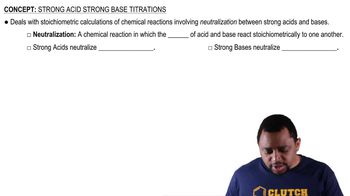
  • Neutralization

    A chemical process where equivalent moles of acid and base react to form water and a salt.
  • Stoichiometry

    A method for calculating quantities in chemical reactions using balanced equations and mole relationships.
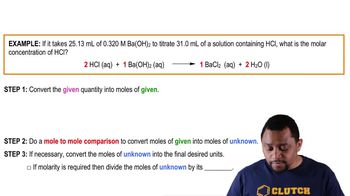
  • Titration

    A laboratory technique for determining the unknown concentration of an acid or base using a controlled reaction.
  • Molarity

    A measure of solution concentration, expressed as moles of solute per liter of solution.
  • Volume

    The amount of space a substance occupies, often measured in liters during solution calculations.
  • Mole

    A unit representing 6.022 x 10²³ particles, used to count entities in chemical reactions.
  • Balanced Equation

    A chemical statement showing equal numbers of each atom on both sides, used for stoichiometric calculations.
  • Coefficient

    A number in a chemical equation indicating the relative amount of each substance involved in the reaction.
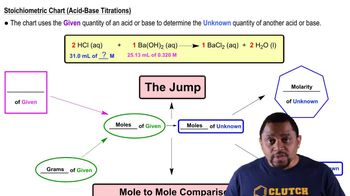
  • Stoichiometric Chart

    A visual tool for tracking conversions between quantities like molarity, volume, and moles in reactions.
  • Hydrochloric Acid

    A common strong acid, often used in titrations, known for complete dissociation in water.
  • Barium Hydroxide

    A strong base that fully dissociates in solution, frequently used in titration examples.
  • Barium Chloride

    A salt produced from the reaction of hydrochloric acid and barium hydroxide during neutralization.
  • Water

    A neutral product formed when hydrogen ions from acids combine with hydroxide ions from bases.