GOB Chemistry
My Course
Learn
Exam Prep
AI Tutor
Study Guides
Textbook Solutions
Flashcards
Explore
Try the app
My Course
Learn
Exam Prep
AI Tutor
Study Guides
Textbook Solutions
Flashcards
Explore
Try the app
Back
Strong Acid Strong Base Titrations (Simplified) quiz
You can tap to flip the card.
What is a strong acid-strong base titration?
You can tap to flip the card.
👆
What is a strong acid-strong base titration?
It is a stoichiometric calculation involving the neutralization reaction between a strong acid and a strong base.
Track progress
Control buttons has been changed to "navigation" mode.
1/15
Related flashcards
Related practice
Recommended videos
Strong Acid Strong Base Titrations (Simplified) definitions
Strong Acid Strong Base Titrations (Simplified)
15 Terms
Strong Acid Strong Base Titrations (Simplified)
10. Acids and Bases
6 problems
Topic

Jules
Henderson-Hasselbalch Equation
10. Acids and Bases
1 problem
Topic
Jules
10. Acids and Bases - Part 1 of 2
6 topics
13 problems
Chapter
Jules
10. Acids and Bases - Part 2 of 2
8 topics
13 problems
Chapter
Jules
Guided course
01:54
Strong Acid Strong Base Titrations (Simplified) Concept 2
2555
views
2
rank
Guided course
02:42
Strong Acid Strong Base Titrations (Simplified) Example 1
2694
views
2
rank
Guided course
01:02
Strong Acid Strong Base Titrations (Simplified) Concept 1
3077
views
4
rank
Terms in this set (15)
Hide definitions
What is a strong acid-strong base titration?
It is a stoichiometric calculation involving the neutralization reaction between a strong acid and a strong base.
How is neutralization defined in the context of titrations?
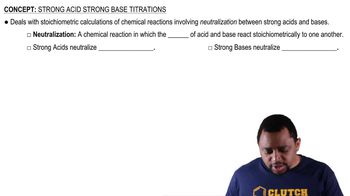
Neutralization is a chemical reaction where the moles of acid and base react stoichiometrically to each other.
Do strong acids only neutralize strong bases?
No, strong acids neutralize bases in general, regardless of whether the base is weak or strong.
What is the main focus of strong acid-strong base titration problems?
The focus is on stoichiometric reactions between strong acids and strong bases, not involving weak acids or bases.
What tool is commonly used to solve titration problems?
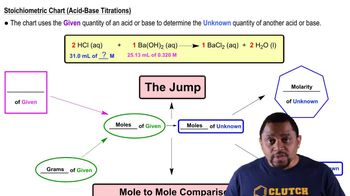
A stoichiometric chart is used to determine unknown quantities of acids or bases.
What information is typically given in a titration problem?
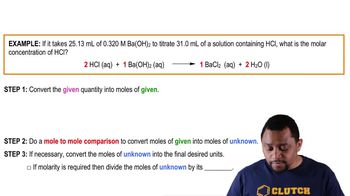
Problems usually provide the volume and molarity of one reactant and the volume of the other.
How do you convert from molarity and volume to moles?
Multiply the molarity by the volume (in liters) to get the number of moles.
What is the next step after finding moles of the given substance?
Use the balanced chemical equation to perform a mole-to-mole comparison to find moles of the unknown.
What do the coefficients in a balanced equation represent in titration calculations?
They indicate the stoichiometric ratio for converting between moles of acid and base.
Once you have moles of the unknown, what can you calculate?
You can calculate either the molarity or the grams of the unknown substance.
What is the relationship between liters, molarity, and moles in titration?
Liters multiplied by molarity gives the number of moles.
Why are weak acids and bases not discussed in this topic?
Because the focus is solely on strong acid and strong base reactions for these titrations.
What is the purpose of a stoichiometric chart in titrations?
It helps organize and solve for unknown quantities using given information and stoichiometric relationships.
What is the first step in solving a titration problem?
Convert the given quantities (usually volume and molarity) into moles.
How is a titration problem similar to other stoichiometry problems?
Both involve using mole relationships from a balanced equation to find unknown quantities.