Back

The Alkyl Groups definitions

Control buttons has been changed to "navigation" mode.
1/15
  • Alkyl Group

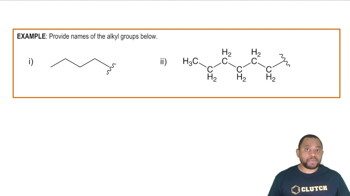
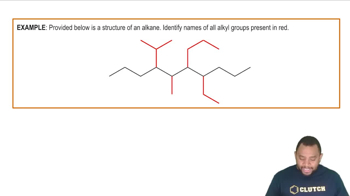
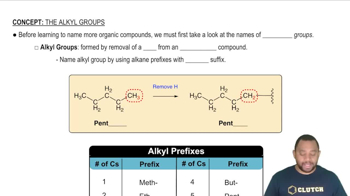
    A fragment derived from an alkane by removing a hydrogen atom, often serving as a branch in larger organic molecules.
  • Alkane

    A saturated hydrocarbon with only single bonds between carbon atoms, serving as the parent structure for alkyl groups.
  • Methyl

    A one-carbon branch derived from methane, commonly represented as CH3– in organic structures.
  • Ethyl

    A two-carbon branch derived from ethane, represented as CH3CH2– and frequently found in organic compounds.
  • Propyl

    A three-carbon straight-chain branch, attached at an end carbon, derived from propane.
  • Isopropyl

    A three-carbon branch attached at the middle carbon, creating a Y-shaped structure, derived from propane.
  • Butyl

    A four-carbon straight-chain branch, attached at an end carbon, derived from butane.
  • Sec-butyl

    A four-carbon branch attached at a secondary carbon, meaning the connection is at a carbon bonded to two other carbons.
  • Isobutyl

    A four-carbon branch with a branching point, where three carbons form a chain and one branches off the middle.
  • Tert-butyl

    A four-carbon branch where a central carbon is connected to three other carbons, forming a compact, cross-shaped structure.
  • Pentyl

    A five-carbon straight-chain branch derived from pentane, often used as a substituent in organic molecules.
  • Hexyl

    A six-carbon straight-chain branch derived from hexane, serving as a substituent in larger compounds.
  • Structural Isomer

    A compound with the same molecular formula as another but with different connectivity of atoms, leading to distinct structures.
  • Secondary Carbon

    A carbon atom bonded to two other carbons, often serving as the attachment point in sec-butyl groups.
  • Tertiary Carbon

    A carbon atom bonded to three other carbons, characteristic of the central atom in tert-butyl groups.