GOB Chemistry
My Course
Learn
Exam Prep
AI Tutor
Study Guides
Textbook Solutions
Flashcards
Explore
My Course
Learn
Exam Prep
AI Tutor
Study Guides
Textbook Solutions
Flashcards
Explore
Back
The Electron Configuration (Simplified) definitions
You can tap to flip the card.
Define:
Periodic Law
You can tap to
flip the card.
👆
Periodic Law
Principle stating that electron arrangements in elements follow recurring patterns, influencing their chemical properties and configurations.
Track progress
Control buttons has been changed to "navigation" mode.
1/14
Related practice
Recommended videos
Guided course
02:15
The Electron Configuration (Simplified) Concept 1
Jules
9072
views
88
rank
Guided course
00:50
The Electron Configuration (Simplified) Example 1
Jules
8115
views
77
rank
Guided course
01:32
The Electron Configuration (Simplified) Concept 2
Jules
8285
views
65
rank
Terms in this set (14)
Hide definitions
Periodic Law
Principle stating that electron arrangements in elements follow recurring patterns, influencing their chemical properties and configurations.
Orbital Diagram
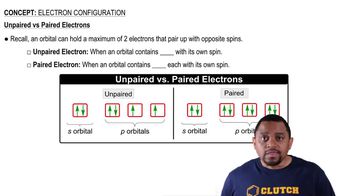
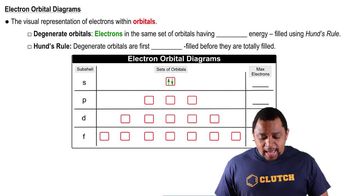
Visual tool showing electron distribution in orbitals, indicating paired and unpaired electrons and their spins.
Degenerate Orbitals
Set of orbitals within a subshell that share the same energy level, filled according to specific rules.
Hund's Rule
Guideline stating that electrons occupy degenerate orbitals singly before pairing, maximizing unpaired electrons.
Sublevel
Division within an energy level, labeled s, p, d, or f, each with a specific number of orbitals and electron capacity.
Aufbau Principle
Rule dictating that electrons fill lower energy orbitals first before occupying higher energy ones.
s Block
Section of the periodic table corresponding to elements with electrons filling s orbitals, holding up to two electrons.
p Block
Periodic table region where electrons fill p orbitals, accommodating up to six electrons across three orbitals.
d Block
Area of the periodic table where electrons fill d orbitals, with a maximum of ten electrons in five orbitals.
f Block
Section representing elements with electrons entering f orbitals, which can hold up to fourteen electrons.
Paired Electrons
Two electrons occupying the same orbital with opposite spins, resulting in a stable configuration.
Unpaired Electrons
Single electrons in an orbital, contributing to magnetic properties and chemical reactivity.
Electron Configuration
Notation describing the distribution of electrons among orbitals and energy levels for an atom or ion.
Spin
Intrinsic property of electrons, with each electron in an orbital having opposite orientations, often depicted as up or down.