Back

The Electron Configuration (Simplified) quiz

Control buttons has been changed to "navigation" mode.
1/15
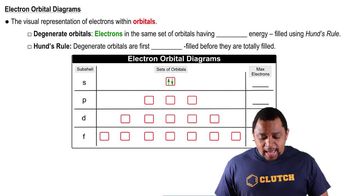
  • What is Hund's rule regarding the filling of degenerate orbitals?

    Hund's rule states that degenerate orbitals are first half-filled before being totally filled.
  • How many electrons can the s sublevel hold?

    The s sublevel can hold a maximum of 2 electrons.
  • How many orbitals are in the p sublevel, and how many electrons can it hold?

    The p sublevel has 3 orbitals and can hold a maximum of 6 electrons.
  • What is the maximum number of electrons the d sublevel can accommodate?

    The d sublevel can hold up to 10 electrons.
  • How many orbitals are in the f sublevel, and what is its electron capacity?

    The f sublevel has 7 orbitals and can hold up to 14 electrons.
  • What principle guides the order in which electrons fill orbitals?

    The Aufbau principle guides electrons to fill lower energy orbitals before higher energy ones.
  • What is the starting point for writing the ground state electron configuration of an element?

    The starting point is the 1s orbital.
  • How does the periodic table help determine electron configurations?

    The periodic table is divided into s, p, d, and f blocks, each corresponding to different orbital types and electron capacities.
  • Why does the d block in the periodic table 'drop down' by one number in electron configuration?

    The d block drops down by one because its orbitals are filled after the s orbital of the next higher energy level.
  • What is the electron configuration for helium?

    Helium's electron configuration is 1s².
  • How are electrons paired within an orbital?

    Electrons pair within an orbital with opposite spins, one up and one down.
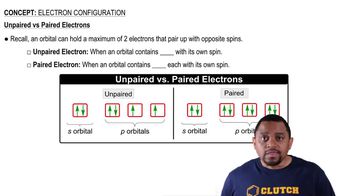
  • What defines an unpaired electron in an orbital diagram?

    An unpaired electron is when an orbital contains only one electron with its own spin.
  • What is a paired electron in an orbital diagram?

    A paired electron is when an orbital contains two electrons with opposite spins.
  • How can you identify an unpaired electron orbital diagram?

    If at least one orbital has a single electron, the diagram is considered an unpaired electron orbital diagram.
  • What is the significance of paired and unpaired electrons in orbital diagrams?

    Paired and unpaired electrons affect the magnetic properties and chemical reactivity of atoms.