Back

Thermal Equilibrium (Simplified) definitions

Control buttons has been changed to "navigation" mode.
1/15
  • Thermal Equilibrium

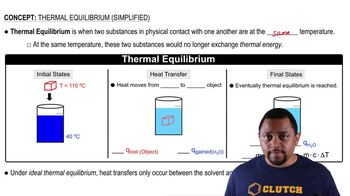
    State where substances in contact reach identical temperatures and stop exchanging thermal energy.
  • Heat Transfer

    Movement of thermal energy from a higher temperature object to a lower temperature one.
  • Temperature

    Measure indicating the thermal state of a substance, determining heat flow direction.
  • Thermal Energy

    Internal energy contained within a substance due to the motion of its particles.
  • Heat

    Form of energy exchanged between substances because of a temperature difference.
  • Q

    Symbol representing the quantity of heat exchanged, assigned positive or negative based on gain or loss.
  • Negative Sign

    Indicator used for heat values when a substance loses thermal energy during transfer.
  • Positive Sign

    Indicator used for heat values when a substance gains thermal energy during transfer.
  • Final Temperature

    Common value reached by all substances in contact after heat exchange ceases.
  • mcat

    Product of mass, specific heat, and temperature change, used to calculate heat exchanged.
  • Ideal Condition

    Scenario where heat exchange occurs only between the substances involved, with no external loss.
  • Solvent

    Substance, often water, that absorbs heat from an immersed object during thermal interaction.
  • Heat Loss

    Process where a hotter object releases thermal energy to its surroundings or another substance.
  • Heat Gain

    Process where a colder object absorbs thermal energy from a hotter substance.
  • Physical Contact

    Direct interaction between substances allowing thermal energy exchange until equilibrium is reached.