Skip to main content
GOB Chemistry
My Course
Learn
Exam Prep
AI Tutor
Study Guides
Textbook Solutions
Flashcards
Explore
Try the app
My Course
Learn
Exam Prep
AI Tutor
Study Guides
Textbook Solutions
Flashcards
Explore
Try the app
Back
Tollens' and Benedict's Test definitions
You can tap to flip the card.
Oxidation
You can tap to flip the card.
👆
Oxidation
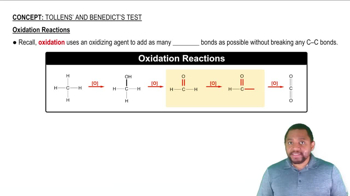
Process increasing carbon-oxygen bonds in a molecule, often by replacing hydrogen with oxygen, without breaking carbon-carbon bonds.
Track progress
Control buttons has been changed to "navigation" mode.
1/13
Related flashcards
Related practice
Recommended videos
Tollens' and Benedict's Test quiz
Tollens' and Benedict's Test
15 Terms
Tollens' and Benedict's Test
15. Aldehydes and Ketones
4 problems
Topic
Jules
Reduction of Aldehydes and Ketones
15. Aldehydes and Ketones
5 problems
Topic
Jules
15. Aldehydes and Ketones
5 topics
13 problems
Chapter
Jules
Guided course
1:17
Tollens' and Benedict's Test Example 1
2625
views
5
rank
Guided course
1:57
Oxidation Reactions Concept 1
2617
views
3
rank
Guided course
1:19
Benedict's Test Concept 3
2553
views
3
rank
Terms in this set (13)
Hide definitions
Oxidation
Process increasing carbon-oxygen bonds in a molecule, often by replacing hydrogen with oxygen, without breaking carbon-carbon bonds.
Aldehyde
Organic compound featuring a carbonyl group bonded to at least one hydrogen, easily oxidized to a carboxylic acid.
Carboxylic Acid
Functional group formed by oxidation of an aldehyde, containing a carbonyl and hydroxyl group on the same carbon.
Tollens' Test
Analytical method using silver oxide and ammonia in basic solution to detect aldehydes by forming a silver mirror.
Silver Mirror
Reflective silver deposit on glassware, indicating a positive Tollens' test for aldehydes.
Silver Precipitate
Solid silver formed during Tollens' test, confirming the presence of an aldehyde.
Benedict's Test
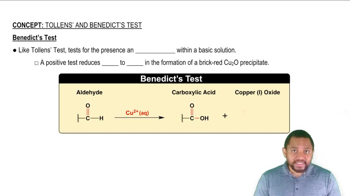
Chemical test using copper(II) ions in basic solution to identify aldehydes by producing a brick red precipitate.
Copper(II) Ion
Blue ion reduced during Benedict's test, serving as the oxidizing agent for aldehydes.
Copper(I) Oxide
Brick red solid formed in Benedict's test, signaling a positive result for aldehydes.
Precipitate
Solid product formed from a solution during a chemical reaction, often indicating a positive test result.
Oxidizing Agent
Substance that facilitates oxidation by accepting electrons, such as silver oxide or copper(II) ion in these tests.
Basic Solution
Aqueous environment with a pH above 7, necessary for both Tollens' and Benedict's tests to proceed.
Reduction
Process involving gain of electrons, such as silver ion becoming silver metal or copper(II) ion becoming copper(I) oxide.
 BackBack
 1:17
1:17