Back

Translation: Protein Synthesis definitions

Control buttons has been changed to "navigation" mode.
1/15
  • Initiation

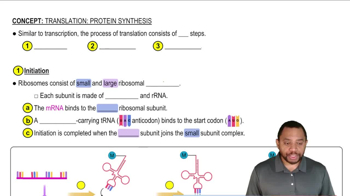
    First stage where mRNA binds to the small ribosomal subunit and the complex forms with methionine-carrying tRNA at the start codon.
  • Elongation

    Middle stage involving sequential addition of amino acids to a growing peptide chain as the ribosome moves along mRNA.
  • Termination

    Final stage where a stop codon is recognized, leading to release of the peptide chain and disassembly of the translation complex.
  • Ribosomal Subunit

    Structural component made of proteins and rRNA, existing as small and large parts that assemble during translation.
  • mRNA

    Single-stranded molecule carrying genetic instructions from DNA, serving as a template for protein synthesis.
  • tRNA

    Adaptor molecule with an anticodon that brings specific amino acids to the ribosome during translation.
  • Codon

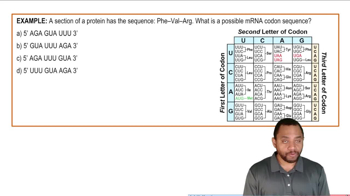
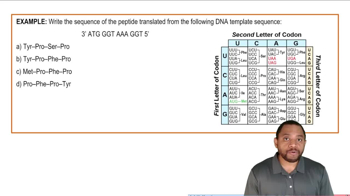
    Three-nucleotide sequence on mRNA specifying a particular amino acid or signaling translation termination.
  • Anticodon

    Three-nucleotide sequence on tRNA that pairs complementarily with a codon on mRNA.
  • Peptide Bond

    Covalent linkage formed between amino acids during protein synthesis, extending the peptide chain.
  • Release Factor

    Protein that recognizes stop codons and triggers hydrolysis, freeing the newly synthesized peptide.
  • Translocation

    Movement of the ribosome along mRNA to the next codon, allowing elongation to continue.
  • Start Codon

    Specific mRNA sequence (AUG) where translation begins, typically coding for methionine.
  • Stop Codon

    mRNA sequence (UAA, UAG, UGA) signaling the end of translation and prompting peptide release.
  • Ribosomal Complex

    Assembly of small and large ribosomal subunits, mRNA, and tRNA, functioning as the site of protein synthesis.
  • Methionine

    Amino acid initially incorporated at the start of translation, often removed from the final protein product.