Back

Translation: Protein Synthesis quiz

Control buttons has been changed to "navigation" mode.
1/15
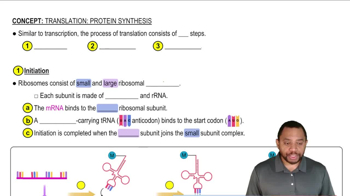
  • What are the three main steps of translation in protein synthesis?

    The three main steps are initiation, elongation, and termination.
  • During initiation, what does the mRNA bind to first?

    The mRNA binds to the small ribosomal subunit first.
  • Which tRNA molecule binds to the start codon during initiation, and what is its anticodon?

    Methionine-carrying tRNA binds to the start codon AUG, and its anticodon is UAC.
  • What completes the initiation step of translation?

    The initiation step is completed when the large ribosomal subunit joins the small subunit to form the ribosomal complex.
  • What is the role of rRNA in the ribosome?

    rRNA (ribosomal RNA) is a structural and functional component of the ribosomal subunits.
  • What happens during the elongation step of translation?

    Amino acids are sequentially added to the growing peptide chain as tRNAs bring them to the ribosome, and peptide bonds form between them.
  • How does the ribosome move along the mRNA during elongation?

    The ribosome translocates to the next codon after the first tRNA leaves, allowing the process to repeat and the peptide chain to grow.
  • What is a peptide bond, and when does it form during translation?

    A peptide bond is a covalent bond between amino acids, and it forms during elongation as new amino acids are added to the chain.
  • Can multiple ribosomes translate the same mRNA simultaneously?

    Yes, multiple ribosomes can translate the same mRNA at the same time, producing multiple peptide chains.
  • What signals the termination of translation?

    Translation terminates when the ribosome encounters a stop codon (UAA, UAG, or UGA) on the mRNA.
  • What is the function of the release factor protein during termination?

    The release factor protein binds to the stop codon, triggering the hydrolysis and release of the peptide chain.
  • What happens to the ribosomal complex after the peptide chain is released?

    The ribosomal subunits, tRNA, and mRNA disassemble after the peptide chain is released.
  • What generally happens to methionine after translation is complete?

    Methionine, which is attached to the start codon, is generally removed from the protein backbone after translation.
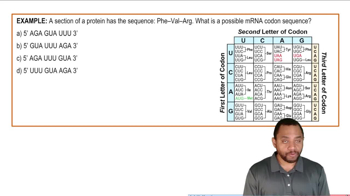
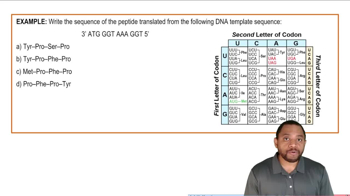
  • What is the significance of the anticodon-codon pairing during translation?

    The anticodon of tRNA pairs with the codon on mRNA to ensure the correct amino acid is added to the growing peptide chain.
  • Why is uracil used instead of thymine in mRNA during translation?

    Uracil is used in RNA (including mRNA) instead of thymine, which is found in DNA.