Skip to main content
GOB Chemistry
My Course
Learn
Exam Prep
AI Tutor
Study Guides
Textbook Solutions
Flashcards
Explore
Try the app
My Course
Learn
Exam Prep
AI Tutor
Study Guides
Textbook Solutions
Flashcards
Explore
Try the app
Back
Triacylglycerols definitions
You can tap to flip the card.
Triacylglycerol
You can tap to flip the card.
👆
Triacylglycerol
A molecule with a glycerol backbone linked to three fatty acids via ester bonds, serving as a primary energy storage form in animals.
Track progress
Control buttons has been changed to "navigation" mode.
1/14
Related flashcards
Related practice
Recommended videos
Triacylglycerols quiz
Triacylglycerols
15 Terms
Triacylglycerols
23. Lipids
5 problems
Topic
Ernest
Triacylglycerol Reactions: Hydrogenation
23. Lipids
4 problems
Topic
KeyshawnDavis
23. Lipids - Part 1 of 3
6 topics
13 problems
Chapter
Ernest
23. Lipids - Part 2 of 3
6 topics
12 problems
Chapter
Nicole
23. Lipids - Part 3 of 3
1 topic
3 problems
Chapter
Guided course
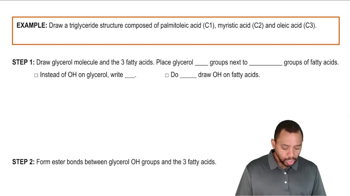
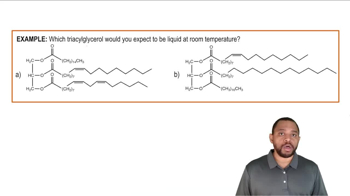
1:16
Triacylglycerols Example 2
3430
views
6
rank
Guided course
3:54
Triacylglycerols Example 1
3340
views
1
rank
Guided course
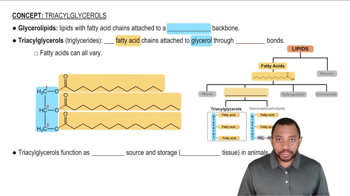
1:52
Triacylglycerols Concept 1
3451
views
3
rank
Terms in this set (14)
Hide definitions
Triacylglycerol
A molecule with a glycerol backbone linked to three fatty acids via ester bonds, serving as a primary energy storage form in animals.
Glycerol
A three-carbon alcohol forming the backbone to which fatty acids attach in certain lipid molecules.
Fatty Acid
A hydrocarbon chain that can vary in length and saturation, forming part of larger lipid molecules.
Ester Bond
A chemical linkage connecting fatty acids to glycerol in lipid structures, crucial for forming triglycerides.
Adipose Tissue
A specialized animal tissue where energy is stored in the form of triglycerides.
Saturation
A property describing the presence or absence of double bonds in fatty acid chains, influencing physical state.
Unsaturated Fatty Acid
A fatty acid containing one or more double bonds, causing bends in the hydrocarbon chain.
Saturated Fatty Acid
A fatty acid with no double bonds, resulting in straight chains that pack efficiently.
Melting Point
The temperature at which a fat or oil transitions from solid to liquid, affected by fatty acid composition.
Pi Bond
A type of covalent bond found in double bonds within fatty acid chains, responsible for chain kinking.
Kinking
A structural bend in fatty acid chains caused by double bonds, preventing tight molecular stacking.
Fats
Solid lipid mixtures at room temperature, typically from animals, with high melting points and few double bonds.
Oils
Liquid lipid mixtures at room temperature, usually from plants, with low melting points and many double bonds.
Glycerolipid
A lipid class featuring fatty acids attached to a glycerol backbone, including triglycerides.
 BackBack

 1:16
1:16