Pearson+ LogoPearson+ Logo
Ch.11 Nucleic Acids Big Molecules with a Big Role
Frost - General, Organic and Biological Chemistry 4th Edition
Frost4th EditionGeneral, Organic and Biological ChemistryISBN: 9780134988696Not the one you use?Change textbook
Chapter 7, Problem 5

What is the difference between ribose and deoxyribose?

Verified step by step guidance
1
Understand that ribose and deoxyribose are both monosaccharides, specifically pentoses, meaning they contain five carbon atoms.
Recognize that ribose is a sugar found in RNA, while deoxyribose is a sugar found in DNA. This distinction is crucial for their biological roles.
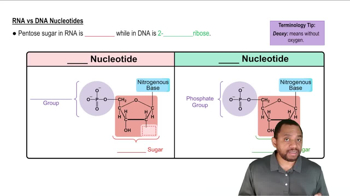
Examine the structural difference: Ribose has a hydroxyl group (-OH) attached to the 2' carbon, whereas deoxyribose has a hydrogen atom (-H) instead of the hydroxyl group at the same position.
Write the chemical formulas: Ribose is C₅H₁₀O₅, and deoxyribose is C₅H₁₀O₄. Note the absence of one oxygen atom in deoxyribose compared to ribose.
Understand the functional implication: The absence of the hydroxyl group in deoxyribose makes DNA more chemically stable than RNA, which is important for its role in long-term genetic storage.

Verified video answer for a similar problem:

This video solution was recommended by our tutors as helpful for the problem above.
Video duration:
1m
Was this helpful?

Key Concepts

Here are the essential concepts you must grasp in order to answer the question correctly.

Ribose

Ribose is a five-carbon sugar (pentose) that is a crucial component of RNA (ribonucleic acid). It has a hydroxyl group (-OH) attached to each of its carbon atoms, which makes it more reactive and versatile in biochemical processes. Ribose plays a key role in the synthesis of nucleotides, the building blocks of RNA, and is involved in energy transfer through molecules like ATP.
Recommended video:
Guided course
1:34
Intro to Nucleic Acids Concept 2

Deoxyribose

Deoxyribose is also a five-carbon sugar, but it differs from ribose by lacking one oxygen atom; specifically, it has a hydrogen atom (-H) instead of a hydroxyl group (-OH) on the second carbon. This structural difference is significant as it contributes to the stability of DNA (deoxyribonucleic acid), making it less reactive than RNA. Deoxyribose is essential for forming the backbone of DNA, which carries genetic information.
Recommended video:
Guided course
1:11
Intro to Nucleic Acids

Nucleic Acids

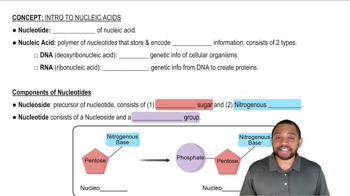
Nucleic acids, including DNA and RNA, are biopolymers essential for all known forms of life. They are composed of long chains of nucleotides, which include a sugar (ribose or deoxyribose), a phosphate group, and a nitrogenous base. The differences in sugar types (ribose in RNA and deoxyribose in DNA) influence the structure and function of these molecules, impacting processes like protein synthesis and genetic inheritance.
Recommended video:
Guided course
1:55
Intro to Nucleic Acids Concept 1