Pearson+ LogoPearson+ Logo
Ch.11 Nucleic Acids Big Molecules with a Big Role
Frost - General, Organic and Biological Chemistry 4th Edition
Frost4th EditionGeneral, Organic and Biological ChemistryISBN: 9780134988696Not the one you use?Change textbook
Chapter 7, Problem 8

List the names and abbreviations of the four nucleotides in RNA.

Verified step by step guidance
1
Understand that RNA (ribonucleic acid) is composed of nucleotides, which are the building blocks of RNA molecules. Each nucleotide consists of a sugar (ribose), a phosphate group, and a nitrogenous base.
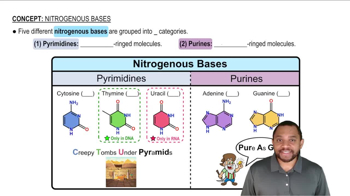
Recognize that RNA contains four nitrogenous bases: adenine (A), cytosine (C), guanine (G), and uracil (U). These bases pair with complementary bases during processes like transcription.
Identify the names and abbreviations of the four nucleotides in RNA: Adenosine (A), Cytidine (C), Guanosine (G), and Uridine (U). These are the nucleotides formed when the nitrogenous bases are attached to the ribose sugar and phosphate group.
Note that the key difference between RNA and DNA is the presence of uracil (U) in RNA instead of thymine (T), which is found in DNA.
Summarize that the four nucleotides in RNA are Adenosine (A), Cytidine (C), Guanosine (G), and Uridine (U), and these are essential for RNA's role in protein synthesis and other cellular functions.

Verified video answer for a similar problem:

This video solution was recommended by our tutors as helpful for the problem above.
Video duration:
53s
Was this helpful?

Key Concepts

Here are the essential concepts you must grasp in order to answer the question correctly.

Nucleotides

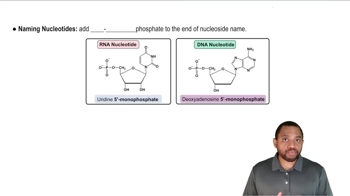
Nucleotides are the building blocks of nucleic acids, such as RNA and DNA. Each nucleotide consists of three components: a phosphate group, a sugar molecule (ribose in RNA), and a nitrogenous base. In RNA, the sequence of these nucleotides encodes genetic information and plays a crucial role in protein synthesis.
Recommended video:
Guided course
1:21
Naming Nucleosides and Nucleotides Concept 2

RNA Structure

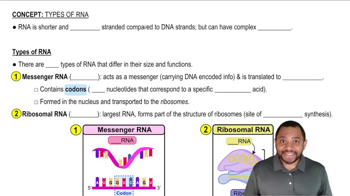
RNA, or ribonucleic acid, is typically single-stranded and plays various roles in cellular processes, including acting as a messenger between DNA and ribosomes for protein synthesis. The structure of RNA allows it to fold into complex shapes, which are essential for its function in catalyzing biochemical reactions and regulating gene expression.
Recommended video:
Guided course
2:43
Types of RNA Concept 1

Nitrogenous Bases in RNA

RNA contains four nitrogenous bases: adenine (A), uracil (U), cytosine (C), and guanine (G). These bases pair with each other during processes like transcription and translation, where adenine pairs with uracil and cytosine pairs with guanine. The specific sequence of these bases determines the genetic code and the resulting protein structure.
Recommended video:
Guided course
1:49
Nitrogenous Bases Concept 1