Pearson+ LogoPearson+ Logo
Ch.11 Nucleic Acids Big Molecules with a Big Role
Frost - General, Organic and Biological Chemistry 4th Edition
Frost4th EditionGeneral, Organic and Biological ChemistryISBN: 9780134988696Not the one you use?Change textbook
Chapter 7, Problem 9a

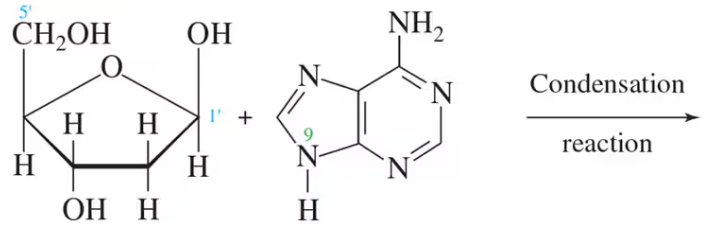
Provide the products for each of the following condensation reactions:
a. Chemical structures illustrating nucleoside and nucleotide formation with a condensation reaction arrow.

Verified step by step guidance
1
Step 1: Identify the reactants in the condensation reaction. The first reactant is a sugar molecule (ribose or deoxyribose) with hydroxyl groups, and the second reactant is a nitrogenous base (adenine).
Step 2: Recognize the functional groups involved in the reaction. The hydroxyl group (-OH) on the 1' carbon of the sugar will react with the hydrogen atom attached to the nitrogen at position 9 of the nitrogenous base.
Step 3: Understand the mechanism of condensation. A condensation reaction involves the removal of a water molecule (H₂O). In this case, the -OH group from the sugar and the H from the nitrogenous base are removed to form water.
Step 4: Predict the product of the reaction. The sugar and nitrogenous base will form a covalent bond between the 1' carbon of the sugar and the nitrogen at position 9 of the base, resulting in a nucleoside.
Step 5: Note the structural change. The product will consist of the sugar molecule covalently bonded to the nitrogenous base, with the water molecule released as a byproduct.

Verified video answer for a similar problem:

This video solution was recommended by our tutors as helpful for the problem above.
Video duration:
1m
Was this helpful?

Key Concepts

Here are the essential concepts you must grasp in order to answer the question correctly.

Condensation Reaction

A condensation reaction is a chemical process where two molecules combine to form a larger molecule, accompanied by the loss of a small molecule, often water. In the context of nucleoside and nucleotide formation, this reaction typically involves the joining of a sugar and a nitrogenous base, resulting in the formation of a glycosidic bond.
Recommended video:
Guided course
1:53
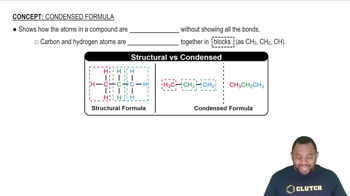
Condensed Formula Concept 1

Nucleoside

A nucleoside is a structural component of nucleic acids, consisting of a nitrogenous base (adenine, guanine, cytosine, or thymine/uracil) attached to a sugar molecule (ribose or deoxyribose). Nucleosides are formed through condensation reactions between a sugar and a base, and they serve as the building blocks for nucleotides.
Recommended video:
Guided course
1:21
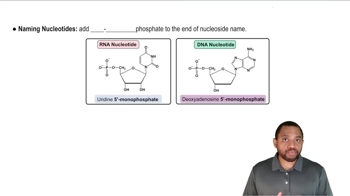
Naming Nucleosides and Nucleotides Concept 2

Nucleotide

A nucleotide is a basic unit of nucleic acids, composed of a nucleoside linked to one or more phosphate groups. Nucleotides are formed from nucleosides through additional condensation reactions that attach phosphate groups, and they play crucial roles in cellular processes, including energy transfer and genetic information storage.
Recommended video:
Guided course
1:21
Naming Nucleosides and Nucleotides Concept 2