
Pearson+ LogoPearson+ Logo
Ch.4 Introduction to Organic Compounds
Frost - General, Organic and Biological Chemistry 4th Edition
Frost4th EditionGeneral, Organic and Biological ChemistryISBN: 9780134988696Not the one you use?Change textbook
Chapter 1, Problem 81c

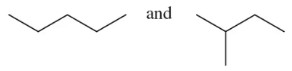
Are the following compounds structural isomers, cistrans isomers, or enantiomers?
(c) 

Verified step by step guidance
1
Step 1: Understand the definitions of the terms involved. Structural isomers are compounds with the same molecular formula but different connectivity of atoms. Cis–trans isomers (a type of stereoisomer) occur when there is restricted rotation (e.g., around a double bond or in a ring structure) and the groups attached to the atoms differ in spatial arrangement. Enantiomers are non-superimposable mirror images of each other, typically involving a chiral center.
Step 2: Examine the molecular formula of the two compounds in the images. Verify if they have the same molecular formula. If they do not, they are not isomers of any kind.
Step 3: Analyze the connectivity of the atoms in the two compounds. If the connectivity differs, the compounds are structural isomers. If the connectivity is the same, proceed to the next step.
Step 4: Check for restricted rotation (e.g., double bonds or ring structures) and the spatial arrangement of groups. If the compounds differ in spatial arrangement around a double bond or ring, they are cis–trans isomers. If not, proceed to the next step.
Step 5: Determine if the compounds are non-superimposable mirror images of each other by identifying chiral centers (atoms bonded to four different groups). If they are mirror images and non-superimposable, they are enantiomers.

Verified video answer for a similar problem:

This video solution was recommended by our tutors as helpful for the problem above.
Video duration:
2m
Was this helpful?

Key Concepts

Here are the essential concepts you must grasp in order to answer the question correctly.

Structural Isomers

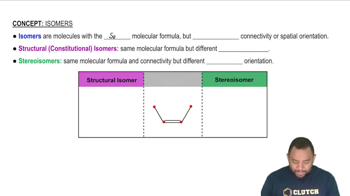
Structural isomers are compounds that have the same molecular formula but differ in the arrangement of atoms within the molecule. This can include variations in the connectivity of the atoms, leading to different functional groups or chain structures. Understanding structural isomers is crucial for identifying how the same set of atoms can form distinct compounds with unique properties.
Recommended video:
Guided course
2:16
Isomers Concept 1

Cis-Trans Isomers

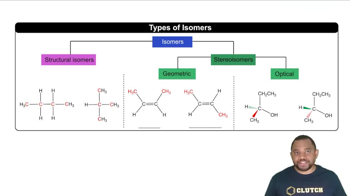
Cis-trans isomers, also known as geometric isomers, occur due to the restricted rotation around a double bond or within a ring structure. In cis isomers, similar groups are on the same side, while in trans isomers, they are on opposite sides. This concept is important for understanding how spatial arrangement affects the physical and chemical properties of compounds.
Recommended video:
Guided course
3:05
Types of Isomers Concept 3

Enantiomers

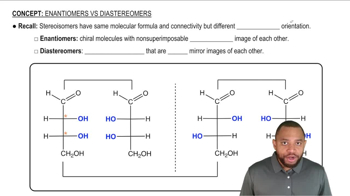
Enantiomers are a type of stereoisomer that are non-superimposable mirror images of each other, typically involving chiral centers in the molecule. They have identical physical properties except for their interaction with polarized light and reactions in chiral environments. Recognizing enantiomers is essential in fields like pharmaceuticals, where the activity of a drug can differ significantly between enantiomers.
Recommended video:
Guided course
3:33
Enantiomers vs Diastereomers Concept 1