Pearson+ LogoPearson+ Logo
Ch.4 Introduction to Organic Compounds
Frost - General, Organic and Biological Chemistry 4th Edition
Frost4th EditionGeneral, Organic and Biological ChemistryISBN: 9780134988696Not the one you use?Change textbook
Chapter 1, Problem 82c

Draw the enantiomer of each of the following compounds. If the compound is not chiral, state that fact.
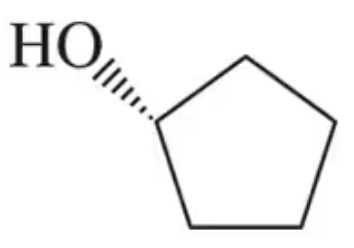
(c) Chemical structure of a pentagon with an -OH group attached, indicating a non-chiral compound.

Verified step by step guidance
1
Analyze the given structure: The compound is a cyclopentane ring with a hydroxyl (-OH) group attached via a wedge bond, indicating stereochemistry.
Determine chirality: A compound is chiral if it has a carbon atom bonded to four different groups and lacks a plane of symmetry. In this case, the carbon attached to the -OH group is bonded to two identical groups (two hydrogens), making the compound achiral.
State the conclusion: Since the compound is not chiral, it does not have an enantiomer.
Explain why enantiomers cannot exist: Enantiomers are non-superimposable mirror images of chiral molecules. Because this molecule is achiral, it cannot have a non-superimposable mirror image.
Summarize: The compound is achiral, and no enantiomer can be drawn for this structure.

Verified video answer for a similar problem:

This video solution was recommended by our tutors as helpful for the problem above.
Video duration:
2m
Was this helpful?

Key Concepts

Here are the essential concepts you must grasp in order to answer the question correctly.

Chirality

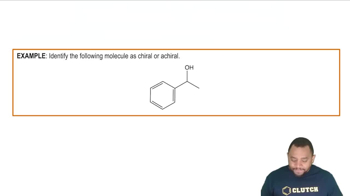
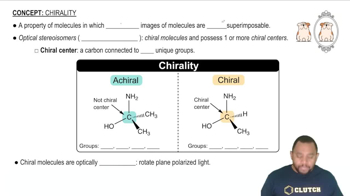
Chirality refers to the geometric property of a molecule that makes it non-superimposable on its mirror image. A chiral molecule typically has four different substituents attached to a central carbon atom, creating two distinct forms known as enantiomers. Understanding chirality is crucial for determining whether a compound can exist in multiple forms that differ in spatial arrangement.
Recommended video:
Guided course
1:39
Chirality Example 1

Enantiomers

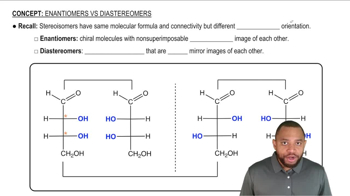
Enantiomers are a pair of molecules that are mirror images of each other but cannot be superimposed. They often exhibit different optical activities, meaning they rotate plane-polarized light in opposite directions. Identifying enantiomers is essential in organic chemistry, especially in the context of pharmaceuticals, where different enantiomers can have vastly different biological effects.
Recommended video:
Guided course
3:33
Enantiomers vs Diastereomers Concept 1

Chiral Centers

A chiral center, often a carbon atom, is a point in a molecule where four different groups are attached, leading to chirality. If a molecule lacks a chiral center, it is considered achiral and does not have enantiomers. In the provided compound, the absence of a chiral center indicates that it is not chiral, and thus, no enantiomer can be drawn.
Recommended video:
Guided course
2:37
Chirality Concept 1