Pearson+ LogoPearson+ Logo
Ch.6 Carbohydrates Life's Sweet Molecules
Frost - General, Organic and Biological Chemistry 4th Edition
Frost4th EditionGeneral, Organic and Biological ChemistryISBN: 9780134988696Not the one you use?Change textbook
Chapter 3, Problem 89a

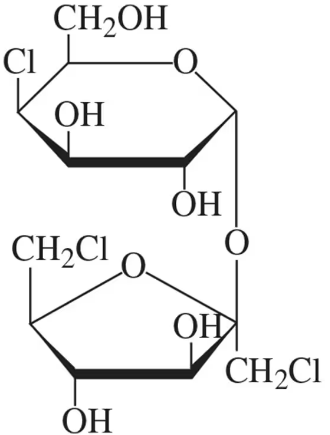
The structure of sucralose, found in the artificial sweetener Splenda, is shown in the figure. It consists of a chlorinated disaccharide made up of galactose and fructose. In its structure shown,
(a) identify the galactose unit and the fructose unit.
Structure of sucralose, a chlorinated disaccharide of galactose and fructose, with units labeled for identification.

Verified step by step guidance
1
Step 1: Understand the structure of sucralose. Sucralose is a chlorinated disaccharide composed of two monosaccharides: galactose and fructose. These units are chemically bonded together to form the disaccharide structure.
Step 2: Examine the provided image of sucralose. Look for the two distinct monosaccharide units within the structure. Each unit will have characteristic features that distinguish galactose from fructose.
Step 3: Identify the galactose unit. Galactose is a six-carbon sugar (hexose) with a specific arrangement of hydroxyl (-OH) groups. In sucralose, the galactose unit will have chlorine atoms replacing some hydroxyl groups, but its core structure remains identifiable.
Step 4: Identify the fructose unit. Fructose is a five-carbon sugar (pentose) with a ketone functional group. In sucralose, the fructose unit will also have chlorine atoms replacing some hydroxyl groups, but its ketone group and overall structure will help distinguish it from galactose.
Step 5: Label the galactose and fructose units in the image. Use the structural features described above to clearly mark which part of the sucralose molecule corresponds to galactose and which corresponds to fructose.

Verified video answer for a similar problem:

This video solution was recommended by our tutors as helpful for the problem above.
Video duration:
3m
Was this helpful?

Key Concepts

Here are the essential concepts you must grasp in order to answer the question correctly.

Disaccharides

Disaccharides are carbohydrates formed by the combination of two monosaccharides through a glycosidic bond. In the case of sucralose, the disaccharide is composed of galactose and fructose. Understanding the structure and properties of disaccharides is essential for identifying their components and their roles in nutrition and sweetness.
Recommended video:
Guided course
3:39
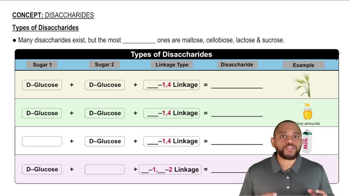
Types of Disaccharides Concept 1

Galactose

Galactose is a monosaccharide that is part of the disaccharide lactose and is commonly found in dairy products. It is an aldohexose, meaning it has six carbon atoms and an aldehyde group. In the context of sucralose, recognizing the galactose unit is crucial for understanding the sweetening properties and the overall structure of the artificial sweetener.
Recommended video:
Guided course
0:50
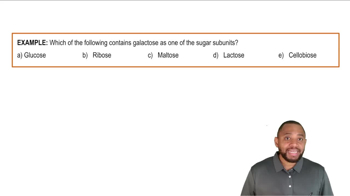
Types of Disaccharides Example 1

Fructose

Fructose is a simple sugar, or monosaccharide, that is found in many plants, where it is often bonded to glucose to form sucrose. It is a key component of many sweeteners, including sucralose. Identifying the fructose unit in the structure of sucralose is important for understanding its sweetness and how it interacts with taste receptors.
Recommended video:
Guided course
0:57
Gluconeogenesis Concept 10
Related Practice
Textbook Question

Glycogen and amylopectin are both branched polymers of glucose. Read the descriptions of each in Section 6.6. Which molecule has a more compact structure? Explain.

1070
views
Textbook Question

On an exam, a student was asked to draw the Fischer projection of L-glucose, but he had only memorized the structure of D-glucose. He wrote the structure of D-glucose and switched the hydroxyl group on C5 from the right to the left. Was his answer correct? If not, what is the name of the aldose that he drew?

657
views
Textbook Question

Carbohydrates are abbreviated using a three-letter abbreviation followed by their glycosidic bond type. For example, maltose and sucrose can be written respectively as

Provide the structure for the O-type blood carbohydrate set given the following abbreviation:

L-Fucα (1→2) Galß(1→4)GlcNAc

701
views
Textbook Question

The structure of sucralose, found in the artificial sweetener Splenda, is shown in the figure. It consists of a chlorinated disaccharide made up of galactose and fructose. In its structure shown, (b) identify the type of glycosidic bond present.

54
views
Textbook Question

Which of the components in starch is more likely to be broken down more quickly in plants, amylose or amylopectin? Why?

708
views
Textbook Question

How much energy is produced if a person eats 50 g of digestible carbohydrate (not fiber) in a day? In this case, what percent of a 2200 Calorie diet would be digestible carbohydrate? Recall that carbohydrates provide four Calories of energy per gram consumed.

755
views