Pearson+ LogoPearson+ Logo
Ch.6 Carbohydrates Life's Sweet Molecules
Frost - General, Organic and Biological Chemistry 4th Edition
Frost4th EditionGeneral, Organic and Biological ChemistryISBN: 9780134988696Not the one you use?Change textbook
Chapter 3, Problem 36a

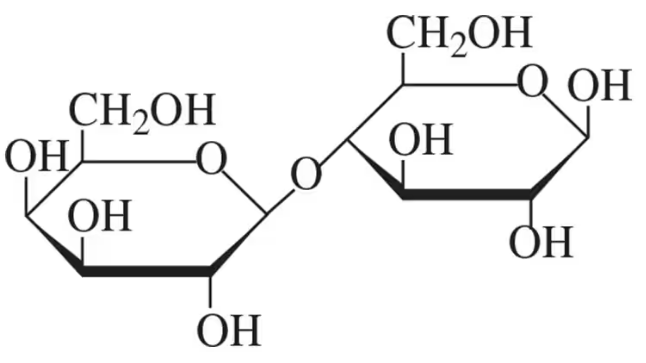
For each of the following disaccharides, name the glycosidic bond and draw the monosaccharide units produced by hydrolysis:
(a) Chemical structure of a disaccharide showing glycosidic linkage and hydroxyl groups on monosaccharide units.

Verified step by step guidance
1
Step 1: Understand the concept of glycosidic bonds. Glycosidic bonds are covalent bonds that connect monosaccharide units in disaccharides. They are formed through a dehydration reaction and can be broken by hydrolysis.
Step 2: Identify the type of glycosidic bond in the disaccharide. Look at the structure provided in the image to determine the position and type of linkage (e.g., α-1,4 or β-1,4). This involves analyzing the orientation of the oxygen atom in the bond and the carbon numbers involved.
Step 3: Hydrolysis of the disaccharide. Hydrolysis is a chemical reaction where water is used to break the glycosidic bond, resulting in the separation of the disaccharide into its monosaccharide components.
Step 4: Draw the monosaccharide units produced by hydrolysis. Based on the structure of the disaccharide, sketch the individual monosaccharides that result from breaking the glycosidic bond. Ensure you represent the correct stereochemistry (α or β forms) and functional groups.
Step 5: Name the monosaccharides and the glycosidic bond. Provide the names of the monosaccharides produced and specify the type of glycosidic bond that was present in the original disaccharide (e.g., α-1,4 glycosidic bond).

Verified video answer for a similar problem:

This video solution was recommended by our tutors as helpful for the problem above.
Video duration:
6m
Was this helpful?

Key Concepts

Here are the essential concepts you must grasp in order to answer the question correctly.

Disaccharides

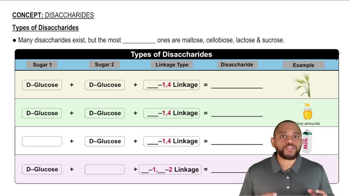
Disaccharides are carbohydrates formed by the condensation of two monosaccharides, linked by a glycosidic bond. Common examples include sucrose, lactose, and maltose. Understanding the structure and composition of disaccharides is essential for identifying the specific glycosidic bonds that connect the monosaccharide units.
Recommended video:
Guided course
3:39
Types of Disaccharides Concept 1

Glycosidic Bond

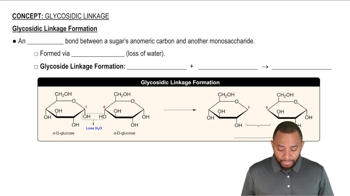
A glycosidic bond is a type of covalent bond that links monosaccharides together in carbohydrates. It is formed through a dehydration reaction, where a water molecule is released. The specific type of glycosidic bond (e.g., α or β) influences the properties and digestibility of the disaccharide.
Recommended video:
Guided course
1:44
Glycosidic Linkage Formation Concept 1

Hydrolysis

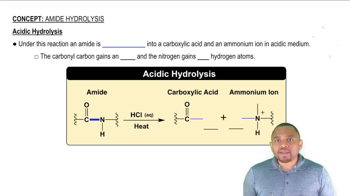
Hydrolysis is a chemical reaction that involves the breaking of a bond in a molecule using water. In the context of disaccharides, hydrolysis results in the separation of the glycosidic bond, yielding the individual monosaccharides. This process is crucial for understanding how disaccharides are metabolized in biological systems.
Recommended video:
Guided course
1:12
Acidic Hydrolysis Concept 1