Pearson+ LogoPearson+ Logo
Ch.6 Carbohydrates Life's Sweet Molecules
Frost - General, Organic and Biological Chemistry 4th Edition
Frost4th EditionGeneral, Organic and Biological ChemistryISBN: 9780134988696Not the one you use?Change textbook
Chapter 3, Problem 39a

Identify a disaccharide that fits each of the following descriptions:
(a) ordinary table sugar

Verified step by step guidance
1
Understand the term 'disaccharide': A disaccharide is a carbohydrate composed of two monosaccharide units joined by a glycosidic bond. Common examples include sucrose, lactose, and maltose.
Recall the common name for ordinary table sugar: Ordinary table sugar is chemically known as sucrose, which is a disaccharide.
Identify the monosaccharides that make up sucrose: Sucrose is composed of one glucose molecule and one fructose molecule linked by a glycosidic bond.
Recognize the source of sucrose: Sucrose is commonly derived from sugarcane or sugar beets and is widely used as a sweetener in food and beverages.
Confirm the description matches sucrose: Ordinary table sugar fits the description of a disaccharide commonly used in households and food preparation, confirming that sucrose is the correct answer.

Verified video answer for a similar problem:

This video solution was recommended by our tutors as helpful for the problem above.
Video duration:
1m
Was this helpful?

Key Concepts

Here are the essential concepts you must grasp in order to answer the question correctly.

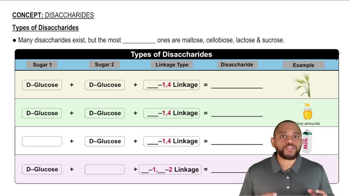
Disaccharides

Disaccharides are carbohydrates formed by the combination of two monosaccharides through a glycosidic bond. They are a type of simple sugar and can be broken down into their constituent monosaccharides by hydrolysis. Common examples include sucrose, lactose, and maltose, each serving different functions in biological systems.
Recommended video:
Guided course
3:39
Types of Disaccharides Concept 1

Sucrose

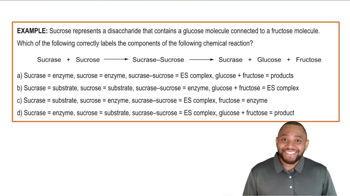
Sucrose is a specific disaccharide composed of glucose and fructose. It is commonly known as table sugar and is widely used as a sweetener in food and beverages. Sucrose is naturally found in many plants, particularly in sugarcane and sugar beets, and is a primary source of energy in the human diet.
Recommended video:
Guided course
1:36
Enzyme-Substrate Complex Example 1

Glycosidic Bond

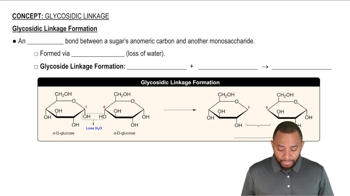
A glycosidic bond is a type of covalent bond that links a carbohydrate (sugar) molecule to another group, which can be another carbohydrate or a different type of molecule. In disaccharides, this bond forms between the hydroxyl group of one sugar and the anomeric carbon of another, resulting in the release of a water molecule during the reaction. This bond is crucial for the formation and stability of disaccharides.
Recommended video:
Guided course
1:44
Glycosidic Linkage Formation Concept 1