Pearson+ LogoPearson+ Logo
Ch.8 Solution Chemistry Sugar and Water Do Mix
Frost - General, Organic and Biological Chemistry 4th Edition
Frost4th EditionGeneral, Organic and Biological ChemistryISBN: 9780134988696Not the one you use?Change textbook
Chapter 5, Problem 102b

Describe the concentration of the solution outside the cell as hypertonic or hypotonic if that solute is being transported across the cell membrane by
(b) facilitated transport.

Verified step by step guidance
1
Understand the terms 'hypertonic' and 'hypotonic': A hypertonic solution has a higher concentration of solutes compared to the inside of the cell, while a hypotonic solution has a lower concentration of solutes compared to the inside of the cell.
Review the concept of facilitated transport: Facilitated transport is a type of passive transport where molecules move across the cell membrane through protein channels or carriers, without requiring energy, and typically down their concentration gradient.
Determine the direction of solute movement: In facilitated transport, solutes move from an area of higher concentration to an area of lower concentration. This means the solute is moving down its concentration gradient.
Analyze the concentration of the solution outside the cell: If the solute is being transported out of the cell via facilitated transport, the solution outside the cell must initially have a lower concentration of solutes (hypotonic) compared to the inside of the cell.
Conclude the relationship: Based on the movement of solutes via facilitated transport, the solution outside the cell can be described as hypotonic relative to the inside of the cell.

Verified video answer for a similar problem:

This video solution was recommended by our tutors as helpful for the problem above.
Video duration:
7m
Was this helpful?

Key Concepts

Here are the essential concepts you must grasp in order to answer the question correctly.

Hypertonic Solution

A hypertonic solution has a higher concentration of solutes compared to the inside of the cell. When a cell is placed in a hypertonic environment, water moves out of the cell to balance solute concentrations, leading to cell shrinkage. This concept is crucial for understanding how cells respond to osmotic pressure and the effects of solute concentration on cell volume.
Recommended video:

Hypotonic Solution

A hypotonic solution has a lower concentration of solutes than the inside of the cell. In this scenario, water moves into the cell, potentially causing it to swell and even burst if the influx is excessive. Understanding hypotonic solutions is essential for grasping how cells maintain homeostasis and manage osmotic balance.
Recommended video:

Facilitated Transport

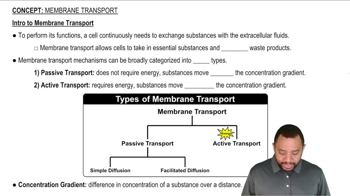
Facilitated transport is a type of passive transport that allows substances to cross membranes with the help of specific transport proteins. This process does not require energy and is crucial for moving polar or charged molecules that cannot easily pass through the lipid bilayer. Recognizing how facilitated transport operates is vital for understanding how cells regulate the movement of solutes in response to their external environment.
Recommended video:
Guided course
1:21
Membrane Transport Concept 1