Pearson+ LogoPearson+ Logo
Ch.10 Acids and Bases
McMurry - Fundamentals of GOB 8th Edition
McMurry8th EditionFundamentals of GOBISBN: 9780134015187Not the one you use?Change textbook
Chapter 10, Problem 41

What happens when a weak base such as NH3 is dissolved in water?

Verified step by step guidance
1
When a weak base like NH₃ (ammonia) is dissolved in water, it reacts with water molecules in a reversible reaction. This means the reaction does not go to completion and establishes an equilibrium.
The weak base NH₃ accepts a proton (H⁺) from a water molecule (H₂O), forming NH₄⁺ (ammonium ion) and OH⁻ (hydroxide ion). The chemical equation for this reaction is: NH3+H2ONH4+OH-
Since NH₃ is a weak base, it does not ionize completely in water. Only a small fraction of NH₃ molecules react with water to form NH₄⁺ and OH⁻ ions, leaving most of the NH₃ molecules unreacted.
The extent of ionization of NH₃ in water is determined by its base dissociation constant, Kb. The Kb value for NH₃ is relatively small, indicating that it is a weak base and produces a low concentration of OH⁻ ions in solution.
The solution becomes slightly basic due to the presence of OH⁻ ions, which increase the pH of the solution. However, the pH will not be as high as that of a strong base because NH₃ does not fully ionize.

Verified video answer for a similar problem:

This video solution was recommended by our tutors as helpful for the problem above.
Video duration:
2m
Was this helpful?

Key Concepts

Here are the essential concepts you must grasp in order to answer the question correctly.

Weak Bases

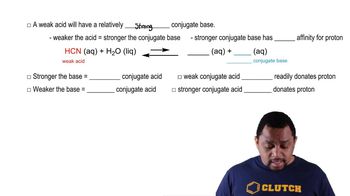
Weak bases are substances that partially ionize in solution, meaning they do not completely dissociate into ions. Ammonia (NH₃) is a common example, which reacts with water to form ammonium ions (NH₄⁺) and hydroxide ions (OH⁻). This partial ionization results in a lower pH compared to strong bases, which fully dissociate.
Recommended video:
Guided course
01:46
Acid and Base Strength Concept 4

Equilibrium in Chemical Reactions

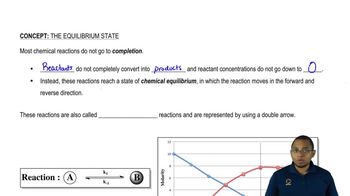
In the context of weak bases, equilibrium refers to the state where the rate of the forward reaction (NH₃ + H₂O ⇌ NH₄⁺ + OH⁻) equals the rate of the reverse reaction. This dynamic balance means that not all NH₃ molecules will convert to ions, leading to a mixture of both reactants and products in solution.
Recommended video:
Guided course
03:42
Chemical Equilibrium Concept 1

pH and Basicity

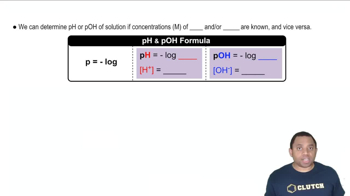
The pH scale measures the acidity or basicity of a solution, with values below 7 indicating acidity and above 7 indicating basicity. When NH₃ dissolves in water, it increases the concentration of hydroxide ions (OH⁻), resulting in a pH greater than 7, thus making the solution basic. The extent of this increase depends on the concentration of the weak base.
Recommended video:
Guided course
02:09
pH and pOH Calculations