
Pearson+ LogoPearson+ Logo
Ch.11 Nuclear Chemistry
McMurry - Fundamentals of GOB 8th Edition
McMurry8th EditionFundamentals of GOBISBN: 9780134015187Not the one you use?Change textbook
Chapter 11, Problem 87

Californium-246 is formed by bombardment of uranium-238 atoms. If four neutrons are formed as by-products, what particle is used for the bombardment?

Verified step by step guidance
1
Step 1: Write the nuclear equation for the reaction. The general form of a nuclear reaction is: \( \text{Target Nucleus} + \text{Bombarding Particle} \rightarrow \text{Product Nucleus} + \text{By-products} \). In this case, the target nucleus is uranium-238 (\( ^{238}_{92}U \)), the product nucleus is californium-246 (\( ^{246}_{98}Cf \)), and four neutrons (\( 4 \; ^{1}_{0}n \)) are by-products.
Step 2: Use the law of conservation of mass number. The sum of the mass numbers (top numbers) on the left side of the equation must equal the sum of the mass numbers on the right side. For uranium-238 and the unknown particle, the total mass number on the left is \( 238 + x \), where \( x \) is the mass number of the unknown particle. On the right, the total mass number is \( 246 + 4 \times 1 \). Set these equal: \( 238 + x = 246 + 4 \).
Step 3: Use the law of conservation of atomic number. The sum of the atomic numbers (bottom numbers) on the left side of the equation must equal the sum of the atomic numbers on the right side. For uranium-238 and the unknown particle, the total atomic number on the left is \( 92 + y \), where \( y \) is the atomic number of the unknown particle. On the right, the total atomic number is \( 98 + 4 \times 0 \). Set these equal: \( 92 + y = 98 \).
Step 4: Solve the equations from Steps 2 and 3. From the mass number equation, solve for \( x \), the mass number of the unknown particle. From the atomic number equation, solve for \( y \), the atomic number of the unknown particle.
Step 5: Identify the unknown particle. Using the values of \( x \) and \( y \) obtained in Step 4, determine the identity of the particle by matching it to a known particle (e.g., proton, neutron, alpha particle, etc.).

Verified video answer for a similar problem:

This video solution was recommended by our tutors as helpful for the problem above.
Video duration:
4m
Was this helpful?

Key Concepts

Here are the essential concepts you must grasp in order to answer the question correctly.

Nuclear Bombardment

Nuclear bombardment refers to the process of bombarding a target nucleus with particles, such as neutrons, protons, or alpha particles, to induce a nuclear reaction. In this context, the bombardment of uranium-238 is essential for producing Californium-246, as it involves the interaction of the uranium nucleus with incoming particles.
Recommended video:
Guided course
02:06
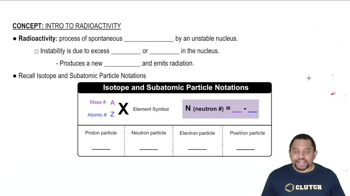
Types of Radiation Concept 1

Neutron Capture

Neutron capture is a specific type of nuclear reaction where a nucleus absorbs a neutron, leading to the formation of a heavier isotope. In the case of uranium-238, the absorption of neutrons during bombardment can lead to the creation of heavier elements, such as Californium-246, while also resulting in the release of additional neutrons as by-products.
Recommended video:
Guided course
01:49
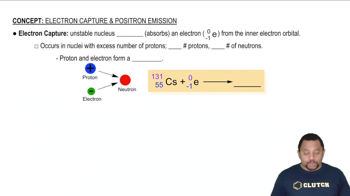
Electron Capture Concept 1

Californium-246

Californium-246 is a synthetic isotope of californium, produced through nuclear reactions involving uranium. It is significant in nuclear chemistry and has applications in neutron detection and as a neutron source. Understanding its formation helps in grasping the broader implications of nuclear reactions and the transmutation of elements.