Pearson+ LogoPearson+ Logo
Ch.3 Ionic Compounds
McMurry - Fundamentals of GOB 8th Edition
McMurry8th EditionFundamentals of GOBISBN: 9780134015187Not the one you use?Change textbook
Chapter 3, Problem 34

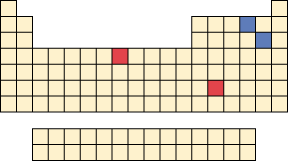
The elements in red in the periodic table can form cations having more than one charge. Write the formulas and names of the compounds that are formed between the red cations and the blue anions depicted in the periodic table.
Periodic table highlighting red elements that form cations with multiple charges and blue elements as anions.

Verified step by step guidance
1
Identify the red elements in the periodic table that can form cations with more than one charge. These are typically transition metals, such as Fe (iron), Cu (copper), and others.
Determine the possible charges (oxidation states) for each red cation. For example, Fe can form Fe²⁺ and Fe³⁺, while Cu can form Cu⁺ and Cu²⁺.
Identify the blue elements in the periodic table that form anions. These are typically nonmetals, such as Cl⁻ (chloride), O²⁻ (oxide), and others.
Combine each red cation with each blue anion to form neutral compounds. Use the crisscross method to balance the charges. For example, if Fe³⁺ combines with Cl⁻, the formula would be FeCl₃ because three Cl⁻ ions are needed to balance the +3 charge of Fe³⁺.
Write the names of the compounds using the Stock system for naming transition metal compounds. For example, FeCl₃ would be named iron(III) chloride, where the Roman numeral indicates the charge of the cation.

Verified video answer for a similar problem:

This video solution was recommended by our tutors as helpful for the problem above.
Video duration:
5m
Was this helpful?

Key Concepts

Here are the essential concepts you must grasp in order to answer the question correctly.

Cations and Anions

Cations are positively charged ions formed when an atom loses one or more electrons, while anions are negatively charged ions created when an atom gains electrons. Understanding the charge of these ions is crucial for predicting how they will combine to form compounds. In this context, the 'red cations' refer to specific metallic elements that can exhibit multiple oxidation states, and the 'blue anions' represent nonmetals or polyatomic ions.
Recommended video:
Guided course
00:37
Naming Monoatomic Anions Example 1

Ionic Compounds

Ionic compounds are formed through the electrostatic attraction between cations and anions. The overall charge of the compound must be neutral, which means the total positive charge from the cations must balance the total negative charge from the anions. This concept is essential for writing correct formulas, as it dictates the ratio of cations to anions in the resulting compound.
Recommended video:
Guided course
02:11
Naming Ionic Compounds

Oxidation States

Oxidation states indicate the degree of oxidation of an atom in a compound, reflecting the number of electrons lost or gained. For elements that can form cations with more than one charge, such as transition metals, knowing the specific oxidation state is vital for determining the correct formula of the ionic compound formed with anions. This understanding helps in accurately naming the compounds based on the charges of the involved ions.
Recommended video:
Guided course
01:01
States of Matter Example 1