Pearson+ LogoPearson+ Logo
Ch.3 Ionic Compounds
McMurry - Fundamentals of GOB 8th Edition
McMurry8th EditionFundamentals of GOBISBN: 9780134015187Not the one you use?Change textbook
Chapter 3, Problem 55

Write the electron configurations of Co, Co2+, and Co3+.

Verified step by step guidance
1
Determine the atomic number of cobalt (Co) from the periodic table. Cobalt has an atomic number of 27, meaning it has 27 electrons in its neutral state.
Write the electron configuration for neutral cobalt (Co) by filling the orbitals in order of increasing energy, following the Aufbau principle. The order is: 1s2, 2s2, 2p6, 3s2, 3p6, 4s2, 3d7. Thus, the configuration for Co is: 1s2 2s2 2p6 3s2 3p6 4s2 3d7.
For Co2+, remove two electrons from the highest energy orbitals. Since the 4s orbital is higher in energy than the 3d orbital, remove the two 4s electrons. The electron configuration for Co2+ is: 1s2 2s2 2p6 3s2 3p6 3d7.
For Co3+, remove one additional electron from the 3d orbital (since it is now the highest energy orbital). The electron configuration for Co3+ is: 1s2 2s2 2p6 3s2 3p6 3d6.
Review the configurations to ensure they follow the principles of electron filling (Aufbau principle, Hund's rule, and Pauli exclusion principle) and confirm that the correct number of electrons has been removed for each ion.

Verified video answer for a similar problem:

This video solution was recommended by our tutors as helpful for the problem above.
Video duration:
1m
Was this helpful?

Key Concepts

Here are the essential concepts you must grasp in order to answer the question correctly.

Electron Configuration

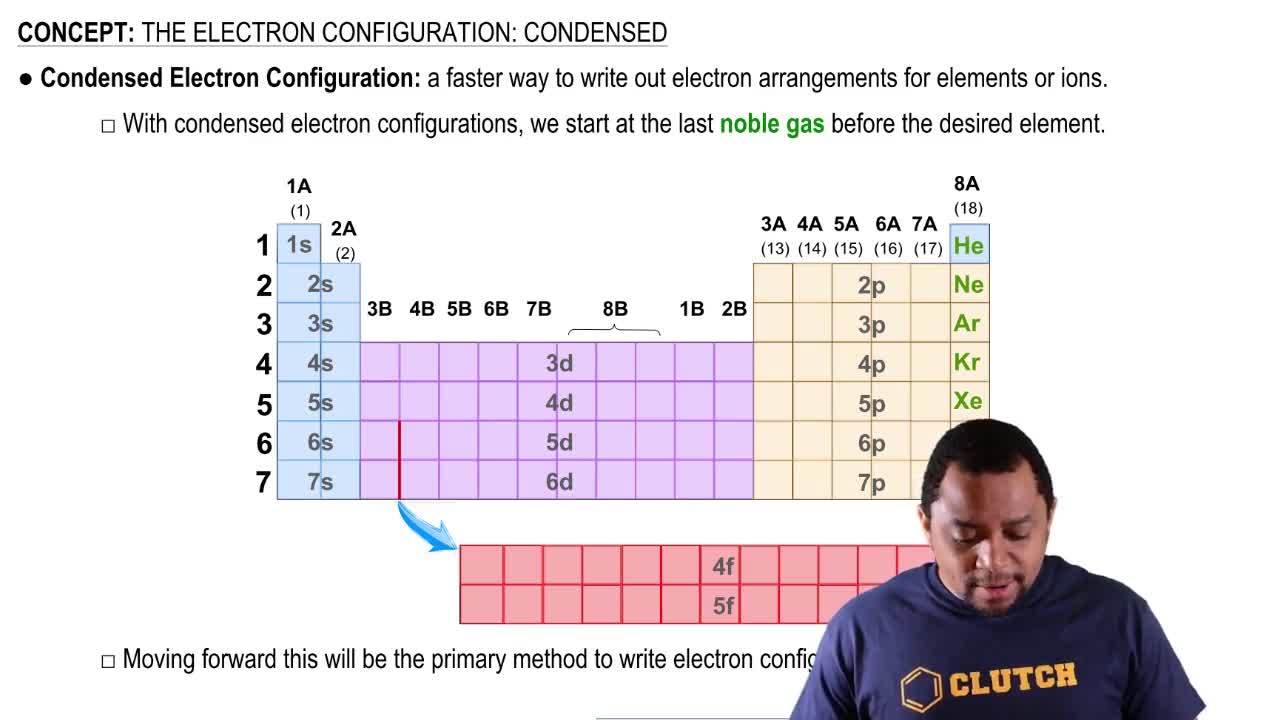
Electron configuration describes the distribution of electrons in an atom's orbitals. It follows the Aufbau principle, which states that electrons fill lower-energy orbitals first, and is typically represented using the notation of subshells (s, p, d, f). Understanding electron configurations is essential for predicting an element's chemical behavior and reactivity.
Recommended video:
Guided course
01:08
The Electron Configuration: Condensed

Transition Metals

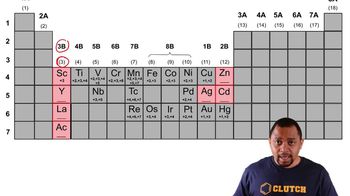
Cobalt (Co) is a transition metal, which are elements found in the d-block of the periodic table. Transition metals are characterized by their ability to form variable oxidation states and complex ions due to the involvement of d electrons in bonding. This property is crucial for understanding the electron configurations of cobalt in its different ionic forms.
Recommended video:
Guided course
02:22
Periodic Table: Transition Metals Charges Concept 1

Oxidation States

Oxidation states indicate the degree of oxidation of an atom in a compound, reflecting the number of electrons lost, gained, or shared. For cobalt, the oxidation states of +2 and +3 correspond to the loss of two and three electrons, respectively. This affects the electron configuration, as the removal of electrons typically occurs from the outermost orbitals, influencing the chemical properties of the ion.
Recommended video:
Guided course
01:01
States of Matter Example 1