Pearson+ LogoPearson+ Logo
Ch.3 Ionic Compounds
McMurry - Fundamentals of GOB 8th Edition
McMurry8th EditionFundamentals of GOBISBN: 9780134015187Not the one you use?Change textbook
Chapter 3, Problem 52

Which of the following ions are likely to form? Explain.
a. Li2+
b. K-
c. Mn3+
d. Zn4+
e. Ne+

Verified step by step guidance
1
Step 1: Understand the stability of ions based on their electron configurations. Ions form when atoms gain or lose electrons to achieve a more stable electron configuration, often resembling the nearest noble gas configuration.
Step 2: Analyze Li^2+. Lithium (Li) has an atomic number of 3, meaning it has 3 electrons. Removing 2 electrons would leave only 1 electron, which is highly unstable. Therefore, Li^2+ is unlikely to form.
Step 3: Analyze K-. Potassium (K) has an atomic number of 19, meaning it has 19 electrons. Adding an extra electron would result in 20 electrons, which would disrupt its stable electron configuration (similar to argon). Potassium typically loses one electron to form K+, so K- is unlikely to form.
Step 4: Analyze Mn^3+. Manganese (Mn) has an atomic number of 25. It can lose electrons to form stable ions, and Mn^3+ is a common oxidation state for manganese in compounds. Therefore, Mn^3+ is likely to form.
Step 5: Analyze Zn^4+ and Ne+. Zinc (Zn) has an atomic number of 30, and losing 4 electrons would require disrupting a stable d10 configuration, making Zn^4+ highly unlikely. Neon (Ne) is a noble gas with a stable electron configuration, and removing an electron to form Ne+ would disrupt this stability, making Ne+ unlikely to form.

Verified video answer for a similar problem:

This video solution was recommended by our tutors as helpful for the problem above.
Video duration:
9m
Was this helpful?

Key Concepts

Here are the essential concepts you must grasp in order to answer the question correctly.

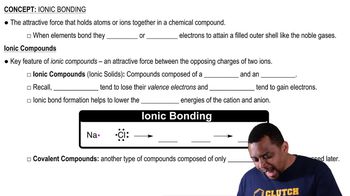
Ionic Charge and Stability

Ionic charge refers to the electrical charge an atom acquires when it loses or gains electrons. Ions with a stable electron configuration, typically resembling that of noble gases, are more likely to form. For example, elements tend to lose or gain electrons to achieve a full outer shell, which influences their likelihood of forming specific ions.
Recommended video:
Guided course
02:33
Ionic Bonding Concept 1

Common Oxidation States

Oxidation states indicate the degree of oxidation of an atom in a compound, reflecting the number of electrons lost or gained. Certain elements have well-known oxidation states; for instance, transition metals like manganese can exhibit multiple oxidation states, such as +3. Understanding these states helps predict which ions are likely to form based on the element's position in the periodic table.
Recommended video:
Guided course
01:01
States of Matter Example 1

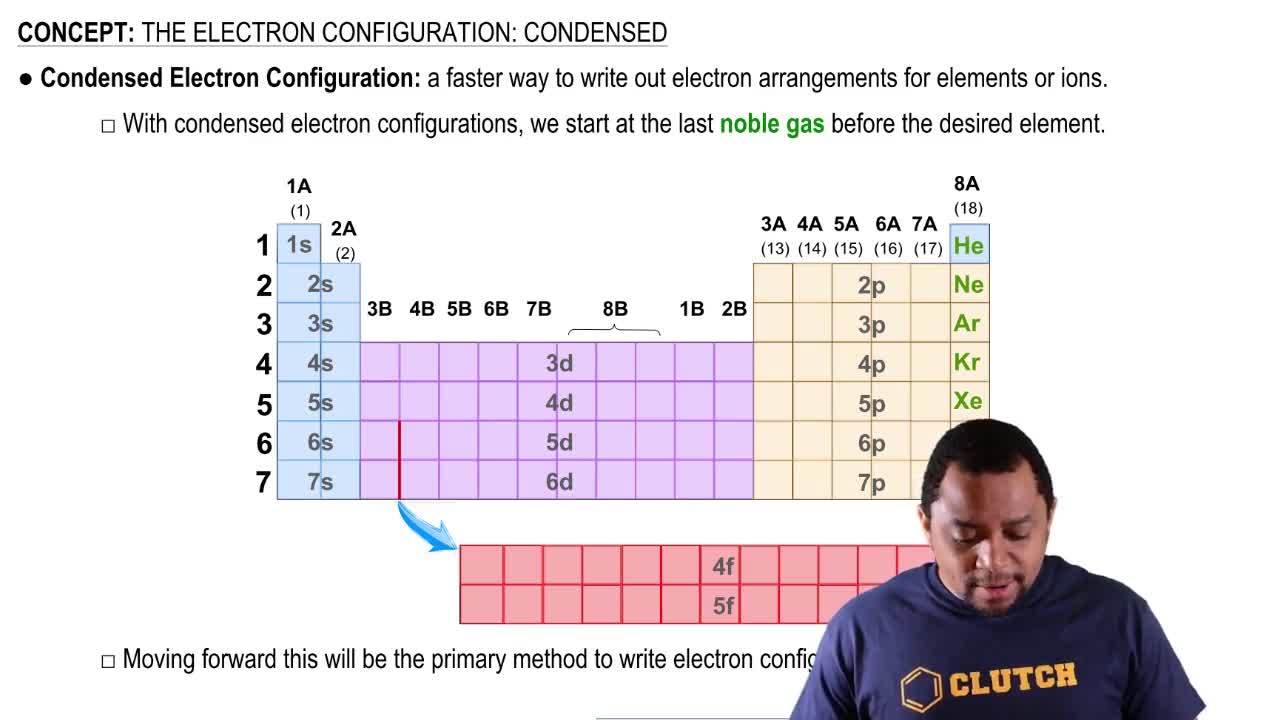
Noble Gas Configuration

Noble gas configuration refers to the electron arrangement of noble gases, which are chemically inert due to their full valence shells. Atoms tend to form ions that achieve this stable configuration. For example, Ne+ suggests a loss of an electron from neon, which is unlikely since neon already has a full outer shell, making it a poor candidate for ion formation.
Recommended video:
Guided course
01:08
The Electron Configuration: Condensed