Pearson+ LogoPearson+ Logo
Ch.6 Chemical Reactions: Mole and Mass Relationships
McMurry - Fundamentals of GOB 8th Edition
McMurry8th EditionFundamentals of GOBISBN: 9780134015187Not the one you use?Change textbook
Chapter 6, Problem 67a

Elemental phosphorus exists as molecules of P4. It reacts with Cl2(g) to produce phosphorus pentachloride.
a. Write the balanced chemical equation for this reaction.

Verified step by step guidance
1
Identify the reactants and products in the reaction. The reactants are phosphorus (P4) and chlorine gas (Cl2), and the product is phosphorus pentachloride (PCl5).
Write the unbalanced chemical equation: P₄ + Cl₂ → PCl₅.
Balance the phosphorus (P) atoms first. Since there are 4 phosphorus atoms in P₄, you will need 4 PCl₅ molecules on the product side. The equation becomes: P₄ + Cl₂ → 4PCl₅.
Next, balance the chlorine (Cl) atoms. Each PCl₅ molecule contains 5 chlorine atoms, so 4 PCl₅ molecules will require 20 chlorine atoms. Since Cl₂ is diatomic, you will need 10 Cl₂ molecules. The equation becomes: P₄ + 10Cl₂ → 4PCl₅.
Verify that the equation is balanced by checking the number of atoms of each element on both sides. There are 4 phosphorus atoms and 20 chlorine atoms on both sides, so the equation is balanced.

Verified video answer for a similar problem:

This video solution was recommended by our tutors as helpful for the problem above.
Video duration:
58s
Was this helpful?

Key Concepts

Here are the essential concepts you must grasp in order to answer the question correctly.

Chemical Equation

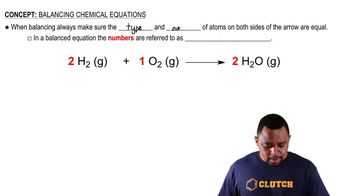
A chemical equation represents a chemical reaction using symbols and formulas. It shows the reactants on the left side and the products on the right, with an arrow indicating the direction of the reaction. Balancing the equation ensures that the number of atoms for each element is the same on both sides, adhering to the law of conservation of mass.
Recommended video:
Guided course
01:32
Balancing Chemical Equations (Simplified) Concept 1

Balancing Chemical Equations

Balancing chemical equations involves adjusting the coefficients of reactants and products to ensure that the total number of atoms for each element is equal on both sides of the equation. This process often requires trial and error, and it is essential for accurately representing the stoichiometry of the reaction, which is crucial for predicting the amounts of substances consumed and produced.
Recommended video:
Guided course
01:32
Balancing Chemical Equations (Simplified) Concept 1

Phosphorus Pentachloride (PCl5)

Phosphorus pentachloride is a chemical compound formed from phosphorus and chlorine, represented by the formula PCl5. It consists of one phosphorus atom bonded to five chlorine atoms. Understanding its formation from elemental phosphorus and chlorine gas is key to writing the balanced equation for the reaction, as it highlights the stoichiometric relationships between the reactants and products.
Recommended video:
Guided course
02:42
Gibbs Free Energy (Simplified) Example 2
Related Practice
Textbook Question

Although Cu is not sufficiently active to react with acids, it can be dissolved by concentrated nitric acid, which functions as an oxidizing agent according to the following equation:

Cu(s) + 4 HNO3(aq) → Cu(NO3)2(aq) + 2 NO2(g) + 2 H2O(l)

b. Is 35.0 g of HNO3 sufficient to dissolve 5.00 g of copper?

1458
views
Textbook Question

Ethyl alcohol is formed by enzyme action on sugars and starches during fermentation.

C6H12O6 → 2 CO2 + 2 C2H6O

If the density of ethyl alcohol is 0.789 g/mL, how many quarts can be produced by the fermentation of 100.0 lb of sugar?

1581
views
Textbook Question

Acetylsalicylic acid, the active ingredient in aspirin, is prepared from salicylic acid by reaction with acetic anhydride.

C7H6O3 (salicylic acid) + C4H6O3 (acetic anhydride) → C9H8O4 (acetylsalicylic acid) + C2H4O2 (acetic acid)

a. Calculate the theoretical yield if 47 g of salicylic acid is reacted with 25 g of acetic anhydride.

2125
views
Textbook Question

Calcium citrate, Ca(C6H5O7)2(MW = 498.5 amu), is a common dietary supplement to provide calcium needed for strong teeth and bones.

a. Look up the recommended daily dietary intake of calcium for adult men and premenopausal women.

1492
views
Textbook Question

Calcium citrate, Ca(C6H5O7)2(MW = 498.5 amu), is a common dietary supplement to provide calcium needed for strong teeth and bones.

b. What mass of calcium citrate would be needed to provide the recommended daily intake of calcium?

1828
views
Textbook Question

Obtain a bottle of aspirin and identify the amount of active ingredient (acetylsalicylic acid, C9H8O4) per tablet.

a. How many moles of aspirin are in one tablet?

1368
views