
Acetylsalicylic acid, the active ingredient in aspirin, is prepared from salicylic acid by reaction with acetic anhydride. C7H6O3 (salicylic acid) + C4H6O3 (acetic anhydride) → C9H8O4 (acetylsalicylic acid) + C2H4O2 (acetic acid) a. Calculate the theoretical yield if 47 g of salicylic acid is reacted with 25 g of acetic anhydride.
Verified step by step guidance
1
Step 1: Write down the balanced chemical equation for the reaction: C7H6O3 (salicylic acid) + C4H6O3 (acetic anhydride) → C9H8O4 (acetylsalicylic acid) + C2H4O2 (acetic acid). This equation is already balanced as written.
Step 2: Calculate the molar masses of the reactants and the product. Use the periodic table to sum the atomic masses of each element in the compounds: C7H6O3 (salicylic acid), C4H6O3 (acetic anhydride), and C9H8O4 (acetylsalicylic acid).
Step 3: Convert the given masses of the reactants into moles. Use the formula: \( \text{moles} = \frac{\text{mass}}{\text{molar mass}} \). For salicylic acid, divide 47 g by its molar mass. For acetic anhydride, divide 25 g by its molar mass.
Step 4: Determine the limiting reactant. Compare the mole ratio of the reactants from the balanced equation (1:1 ratio) to the calculated moles of each reactant. The reactant that produces fewer moles of acetylsalicylic acid is the limiting reactant.
Step 5: Calculate the theoretical yield of acetylsalicylic acid. Use the moles of the limiting reactant and the 1:1 mole ratio from the balanced equation to find the moles of acetylsalicylic acid produced. Then, convert the moles of acetylsalicylic acid to grams using its molar mass: \( \text{mass} = \text{moles} \times \text{molar mass} \).
Verified video answer for a similar problem:
This video solution was recommended by our tutors as helpful for the problem above
Video duration:
2m
Play a video:
Was this helpful?
Key Concepts
Here are the essential concepts you must grasp in order to answer the question correctly.
Stoichiometry
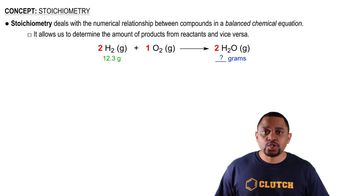
Stoichiometry is the branch of chemistry that deals with the quantitative relationships between reactants and products in a chemical reaction. It allows chemists to predict the amounts of substances consumed and produced in a reaction based on balanced chemical equations. Understanding stoichiometry is essential for calculating theoretical yields, as it helps determine the limiting reactant and the maximum amount of product that can be formed.
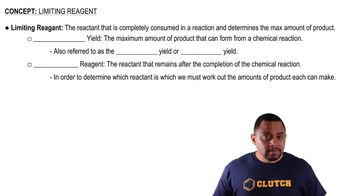
The limiting reactant is the substance that is completely consumed first in a chemical reaction, thus determining the maximum amount of product that can be formed. Identifying the limiting reactant is crucial for yield calculations, as it dictates how much of the other reactants will be used. In the given reaction, one must compare the mole ratios of salicylic acid and acetic anhydride to find which one limits the production of acetylsalicylic acid.
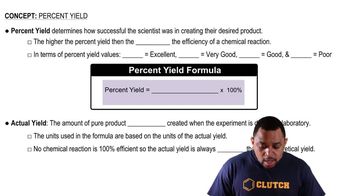
Theoretical yield is the maximum amount of product that can be generated from a given amount of reactants, assuming complete conversion and no losses. It is calculated using stoichiometric relationships derived from the balanced chemical equation. The theoretical yield provides a benchmark against which actual yields can be compared, helping to assess the efficiency of a reaction and the effectiveness of the reactants used.