
Pearson+ LogoPearson+ Logo
Ch.6 Chemical Reactions: Mole and Mass Relationships
McMurry - Fundamentals of GOB 8th Edition
McMurry8th EditionFundamentals of GOBISBN: 9780134015187Not the one you use?Change textbook
Chapter 6, Problem 57a

When table sugar (sucrose, C12H22O11) is heated, it decomposes to form C and H2O.
a. Write a balanced equation for the process.

Verified step by step guidance
1
Identify the reactant and products in the reaction. The reactant is sucrose (C₁₂H₂₂O₁₁), and the products are carbon (C) and water (H₂O).
Write the unbalanced chemical equation: C₁₂H₂₂O₁₁ → C + H₂O.
Balance the carbon (C) atoms. There are 12 carbon atoms in sucrose, so place a coefficient of 12 in front of C on the product side: C₁₂H₂₂O₁₁ → 12C + H₂O.
Balance the hydrogen (H) atoms. There are 22 hydrogen atoms in sucrose, so place a coefficient of 11 in front of H₂O on the product side: C₁₂H₂₂O₁₁ → 12C + 11H₂O.
Verify that the oxygen (O) atoms are balanced. Sucrose has 11 oxygen atoms, and the 11H₂O molecules also contain 11 oxygen atoms. The equation is now balanced: C₁₂H₂₂O₁₁ → 12C + 11H₂O.

Verified video answer for a similar problem:

This video solution was recommended by our tutors as helpful for the problem above.
Video duration:
59s
Was this helpful?

Key Concepts

Here are the essential concepts you must grasp in order to answer the question correctly.

Decomposition Reaction

A decomposition reaction is a type of chemical reaction where a single compound breaks down into two or more simpler products. In the case of sucrose, when heated, it decomposes into carbon (C) and water (H2O). Understanding this concept is crucial for writing the balanced equation, as it highlights the transformation of the reactant into its constituent elements.
Recommended video:
Guided course
1:30
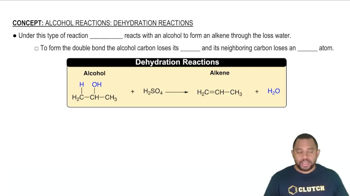
Alcohol Reactions: Dehydration Reactions Concept 1

Balancing Chemical Equations

Balancing chemical equations involves ensuring that the number of atoms of each element is the same on both sides of the equation. This is based on the law of conservation of mass, which states that matter cannot be created or destroyed in a chemical reaction. Proper balancing is essential for accurately representing the reaction of sucrose decomposition.
Recommended video:
Guided course
01:32
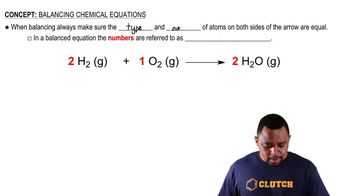
Balancing Chemical Equations (Simplified) Concept 1

Stoichiometry

Stoichiometry is the calculation of reactants and products in chemical reactions based on their molar ratios. It allows chemists to predict the amounts of substances consumed and produced in a reaction. In the context of the sucrose decomposition, stoichiometry helps in determining the correct coefficients needed to balance the equation, ensuring that the reaction adheres to the principles of mass conservation.
Recommended video:
Guided course
01:16
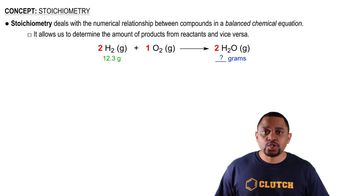
Stoichiometry
Related Practice
Textbook Question

In Problem 6.40, hydrazine reacted with oxygen according to the following (unbalanced) equation: N2H4(l) + O2(g) → NO2(g) + H2O(g)

a. If 75.0 kg of hydrazine are reacted with 75.0 kg of oxygen, which is the limiting reagent?

1650
views
Textbook Question

Nitrobenzene (C6H5NO2) is used in small quantities as a flavoring agent or in perfumes but can be toxic in large amounts. It is produced by reaction of benzene (C6H6) with nitric acid:

C6H6(l) + HNO3(aq) → C6H5NO2(l) + H2O(l)

a. Identify the limiting reagent in the reaction of 27.5 g of nitric acid with 75 g of benzene.

2148
views
Textbook Question

Nitrobenzene (C6H5NO2) is used in small quantities as a flavoring agent or in perfumes but can be toxic in large amounts. It is produced by reaction of benzene (C6H6) with nitric acid:

C6H6(l) + HNO3(aq) → C6H5NO2(l) + H2O(l)

b. Calculate the theoretical yield for this reaction.

2158
views
Textbook Question

When table sugar (sucrose, C12H22O11) is heated, it decomposes to form C and H2O.

b. How many grams of carbon are formed by the breakdown of 60.0 g of sucrose?

2192
views
Textbook Question

Although Cu is not sufficiently active to react with acids, it can be dissolved by concentrated nitric acid, which functions as an oxidizing agent according to the following equation:

Cu(s) + 4 HNO3(aq) → Cu(NO3)2(aq) + 2 NO2(g) + 2 H2O(l)

b. Is 35.0 g of HNO3 sufficient to dissolve 5.00 g of copper?

1459
views
Textbook Question

Ethyl alcohol is formed by enzyme action on sugars and starches during fermentation.

C6H12O6 → 2 CO2 + 2 C2H6O

If the density of ethyl alcohol is 0.789 g/mL, how many quarts can be produced by the fermentation of 100.0 lb of sugar?

1584
views