Pearson+ LogoPearson+ Logo
Ch.8 Gases, Liquids and Solids
McMurry - Fundamentals of GOB 8th Edition
McMurry8th EditionFundamentals of GOBISBN: 9780134015187Not the one you use?Change textbook
Chapter 8, Problem 53

Which assumptions of the kinetic–molecular theory explain the behavior of gases described by Charles's law? Explain your answer.

Verified step by step guidance
1
Charles's law states that the volume of a gas is directly proportional to its temperature (in Kelvin) when pressure and the amount of gas are held constant. This can be expressed mathematically as: VT.
The kinetic–molecular theory (KMT) provides a framework to understand the behavior of gases. One key assumption of KMT is that the average kinetic energy of gas particles is directly proportional to the absolute temperature of the gas. As temperature increases, the particles move faster.
When gas particles move faster due to an increase in temperature, they collide with the walls of the container more frequently and with greater force. To maintain constant pressure, the volume of the gas must increase to allow the particles more space to move and reduce the frequency of collisions per unit area.
Another assumption of KMT is that gas particles are in constant, random motion and that the volume of the particles themselves is negligible compared to the volume of the container. This allows the gas to expand freely when temperature increases, consistent with Charles's law.
In summary, the assumptions of the kinetic–molecular theory that explain Charles's law are: (1) the direct proportionality of kinetic energy to temperature, and (2) the negligible volume of gas particles, which allows the gas to expand as temperature increases to maintain constant pressure.

Verified video answer for a similar problem:

This video solution was recommended by our tutors as helpful for the problem above.
Video duration:
2m
Was this helpful?

Key Concepts

Here are the essential concepts you must grasp in order to answer the question correctly.

Kinetic-Molecular Theory

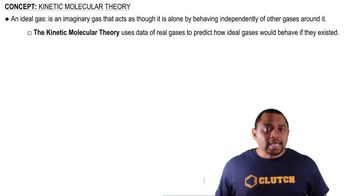
The kinetic-molecular theory posits that gas consists of a large number of small particles in constant, random motion. This theory explains the properties of gases, including pressure, temperature, and volume, by relating them to the motion and energy of the gas particles. It assumes that gas particles are far apart, have negligible volume, and experience elastic collisions, which are crucial for understanding gas behavior.
Recommended video:
Guided course
01:19
Kinetic Molecular Theory Concept 1

Charles's Law

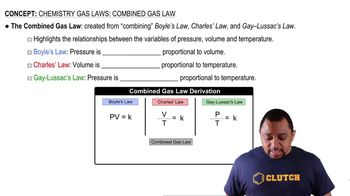
Charles's Law states that the volume of a gas is directly proportional to its absolute temperature when pressure is held constant. This relationship implies that as the temperature of a gas increases, its particles move more vigorously, leading to an increase in volume. Understanding this law is essential for analyzing how temperature changes affect gas behavior under constant pressure conditions.
Recommended video:
Guided course
01:43
Chemistry Gas Laws: Combined Gas Law

Assumptions of Ideal Gases

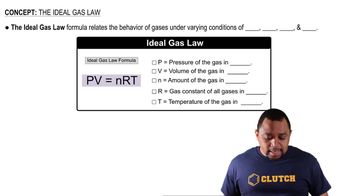
The assumptions of ideal gases include that gas particles do not attract or repel each other and that they occupy no volume. These assumptions simplify the behavior of gases and allow for the derivation of gas laws, including Charles's Law. While real gases may deviate from these assumptions under high pressure or low temperature, they provide a foundational understanding of gas behavior in ideal conditions.
Recommended video:
Guided course
01:15
The Ideal Gas Law Concept 1